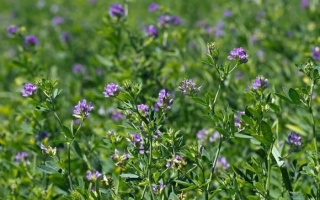
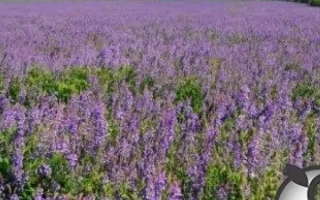
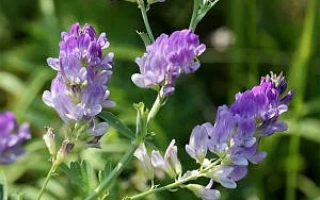
Lucerne variety "Rainbow" is a upright bush with strong branching and a medium-thick, branched stem reaching up to 95 cm in the first cut when grown on fallow land. Leaves are medium-sized, slightly drooping, ovate in shape, with a leafiness of 47-50%. Inflorescence — a dense, medium-length raceme with light-purple flowers. Pods are brown, medium-sized, with 2-3.5 twists, seeds are yellow, medium-sized, kidney-shaped. The vegetative period from emergence to the first cut is 52-68 days, to the second cut — 25-42 days, and to full seed maturity — 110-115 days. The variety is characterized by high winter hardiness, drought and seed pest resistance above average, medium resistance to fungal diseases, and high resistance to root rot. During summer on fallow land, "Rainbow" yields 2-3 cuts, and under irrigation — 4-5 cuts. A biological feature of the variety is its high yield of green mass in the first cut. The average yield over test years was 642 centners per hectare of green mass, 142.5 centners per hectare of hay, and up to 7 centners per hectare of seeds. Lucerne "Rainbow" is an important source of plant protein in feed used both in winter and summer rations. It contains 19-20% protein and 21-22% fiber in dry matter. Dry matter yield reaches 130-140 centners per hectare, and seed yield — 4.0-5.0 centners per hectare. Due to its high nutritional value and productivity, this variety is widely used for feed preparation and improving feed bases.