


SKU #68546
·
53 views
Alfalfa KUBAN YELLOW
Lucerne
User rating
0 votes0% positive reviews
No ratings yet — be the first.
Plant Height
60-90
Registration year
1948
Prices in stores
from5.4 €per 1 kg
pack from 5.4 € per 1 kg
1 offer from 1 store
Store offers · 1 from 1 stores
Prices are updated on loadLoading offers…
Available at: Sadtagorod
Aggregator catalog: prices are collected automatically from store websites, normalized by AI and converted at the current exchange rate. Before ordering, confirm the price and availability on the store's website. This block is not indexed by search engines — the data is loaded after the page opens.
About product

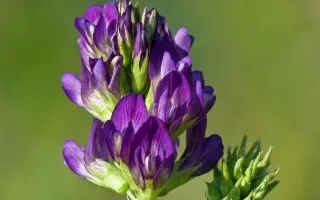
Kuban Yellow Lucerne is a perennial forage crop created at the Federal State Research Center of Grain Crops named after I.G. Kalinenko and included in the State Register of Breeding Achievements of Russia. This variety belongs to the group of yellow lucernes and is characterized by a semi-spreading bush 60-90 cm high. Flower spikes are dense, 5-7 cm long, with straight linear pods that easily spli…
Plant Height
60-90
Registration year
1948
Description
Kuban Yellow Lucerne is a perennial forage crop created at the Federal State Research Center of Grain Crops named after I.G. Kalinenko and included in the State Register of Breeding Achievements of Russia. This variety belongs to the group of yellow lucernes and is characterized by a semi-spreading bush 60-90 cm high. Flower spikes are dense, 5-7 cm long, with straight linear pods that easily split when ripe. Seeds are small, predominantly hard-seeded, weighing 0.7-1.3 mm. Kuban Yellow Lucerne is characterized by late maturity and can grow in one place for 8-10 years, making it a stable and long-lasting crop.
This variety is widely used for improving natural forage lands, sowing in mixtures and forage crop rotations, especially in the dry steppe zone of the Rostov region and the central areas of the Non-Black Soil Zone of Russia. Lucerne is well adapted to various climatic conditions, has high winter hardiness and drought resistance, as well as disease resistance. Under the conditions of southern Russia, it is successfully cultivated on irrigated lands, providing high yields of green mass, hay and seeds.
The forage qualities of the variety are high: the green mass contains about 21.33% crude protein, 28.72% dry matter and 33% fiber. When fed raw, it does not cause tympany in animals, which increases its value as a forage crop. Kuban Yellow Lucerne is also a good honey plant. Due to its powerful root system and trifoliate leaves, it provides stable animal nutrition and contributes to the development of agriculture.
This variety is widely used for improving natural forage lands, sowing in mixtures and forage crop rotations, especially in the dry steppe zone of the Rostov region and the central areas of the Non-Black Soil Zone of Russia. Lucerne is well adapted to various climatic conditions, has high winter hardiness and drought resistance, as well as disease resistance. Under the conditions of southern Russia, it is successfully cultivated on irrigated lands, providing high yields of green mass, hay and seeds.
The forage qualities of the variety are high: the green mass contains about 21.33% crude protein, 28.72% dry matter and 33% fiber. When fed raw, it does not cause tympany in animals, which increases its value as a forage crop. Kuban Yellow Lucerne is also a good honey plant. Due to its powerful root system and trifoliate leaves, it provides stable animal nutrition and contributes to the development of agriculture.
Crop & resistance
Crop
Specifications
| Plant Height | 60-90 |
|---|---|
| Registration year | 1948 |
| Catalog | Catalog → Lucerne |
| Legal data | |
| Country | Russia |
Not yet комментариев. Be the first!
See also
Often considered together with this variety


Recently viewed
Products you’ve viewed on this site
Reviews · 0