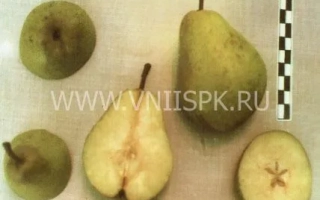
An old French autumn variety, developed by sowing seeds of unknown origin at the end of the 18th century near Apremont in France. Named after the French pomologist Bosca.
The most widely grown autumn pear variety. Approved for cultivation in Russia, the Transcaucasian republics, the foothill and central zones of the Stavropol Krai, the foothill and Black Sea zones of the Krasnodar Krai, Ukraine (Dniester, Carpathians, mountain zone of Zakarpattia, Crimea), Moldova, Georgia, Armenia, and the republics of Central Asia.
The tree exhibits vigorous growth in its early years. As it matures, it forms a large, sparse, asymmetrical pyramidal crown. Branches are long and curved. Fruit set occurs on spurs and shoots.
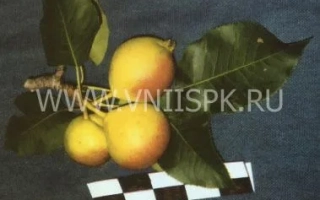
Shoots are thick and gray-brown; buds are small, and buds are closely pressed. Leaves are large, egg-shaped, dark green, thick, with a pointed tip, entire margins; leaf surface is smooth, petiole short.
Flowers are large, wide-open, 10-20 per inflorescence, petals are elongated-oval with wavy serrated edges, cold-resistant, bloom late, thus avoiding spring frosts. Stigmas are shorter than stamens.
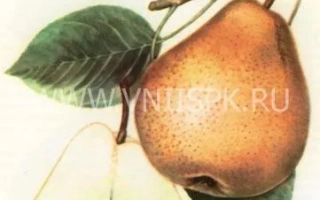
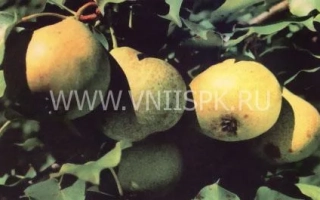
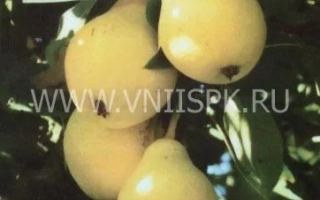
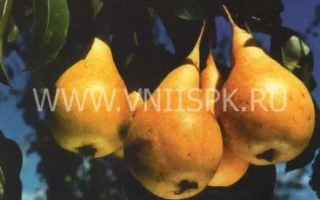
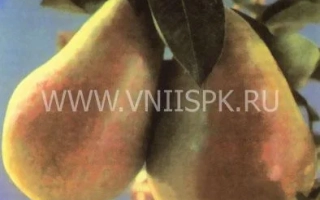
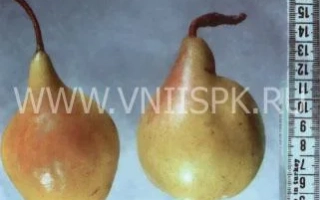
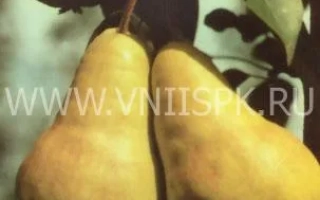
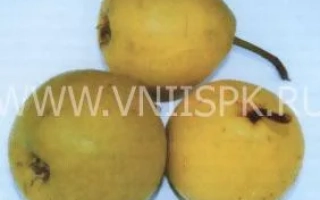
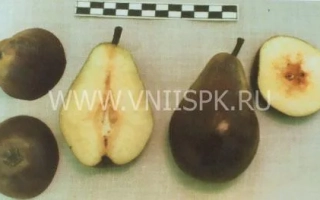
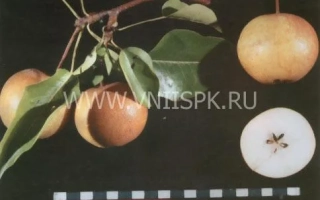
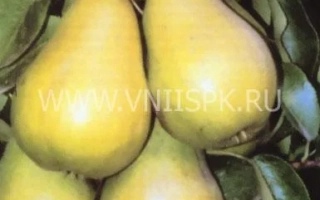
Fruits are above average or large, weighing 150-220 g, attractive in appearance, elongated-bottle shaped, although on the same tree, fruits often differ in shape. Skin is thin, yellowish-brown, entirely rusted, rough, turning golden-rusty at maturity. Peduncle is long, curved, thick; depression is almost absent, the cup cavity is flat, narrow, slightly wrinkled walls, open calyx. Seed cavity is large, bulbous, upper; seeds are small, broad, short-oval, dark, well-formed.
Flesh is white or cream-colored, tender, melting, very juicy and sweet, fragrant, with almond flavor and aroma, excellent taste (4.4-4.8 points).
Fruits contain 14.7% dry extractives, 9.0% sugars, 0.2% titratable acids, 4.6 mg/100g ascorbic acid, 42.3 mg/100g raw material of P-active catechins.
Harvesting period is from September 5 to 15. Storage life is 25-30 days.
Fruits are transportable, set in pairs and triplets, but firmly remain on the tree and even at maturity do not drop off, ripening asynchronously.
Trees enter fruiting at 6-7 years after planting in orchards. Average yield in the central part of Kuban at ages 16-19 years — 80-100 centners/ha, in the southern-eastern subzone of the foothill zone at ages 24-29 years — 160-180 centners/ha.
The tree is not demanding of soil conditions, grows and fruits well with adequate irrigation on light-textured soils. Propagated only on seedling rootstocks of wild pear or seedlings of cultivated varieties; grafting onto quince requires an intermediate stock.
Winter hardiness is insufficient in the Krasnodar Krai, except for the Black Sea coast and foothill zone. Drought resistance is low. According to K. K. Dushutina, the Bere Bosk variety in Moldova belongs to the group of least winter-hardy varieties. The variety is weakly affected by scab.
Advantages of the variety: attractive and high-quality fruits, non-shedding and good transportability. Relative resistance to scab.
Disadvantages of the variety: weak winter hardiness and low drought resistance of trees.
Bere Bosk has been widely used in breeding. With its participation, about twenty new varieties have been developed, seven of which are approved, including at the All-Russian Research Institute of Flower and Subtropical Crops: Verben (Bere Bosk — open pollination) and Chernomorskaya Yantaraya (both Bere Bosk — open pollination), and Rassvet (Bere Bosk Ch Memory of the Congress); at the Daghestan Fruit Breeding Experimental Station, the variety Bergamot Daghestan (Bere Bosk Ch Williams) was developed; at the Siberian Fruit Research Institute, the variety Svarog (Ussuriyskaya Ch Bere Bosk) was developed; and at the Sverdlovsk Fruit Experimental Station, the variety Tikhonovka (Ussuriyskaya Ch Bere Bosk) was obtained.