


SKU #4510
·
212 views
Memory Zhukhovu
Currant
User rating
0 votes0% positive reviews
No ratings yet — be the first.
Type of Sort
Blackcurrant
About product

Medium-late maturing variety, developed at Saint Petersburg State Agricultural Academy (LSHI) by pollinating the Altai 'Stakhanovka' variety with a pollen mixture of 'Vystavochnaya' and 'Neosypanaya' varieties. Author: E.I. Glebova. For many years it was the leading industrial variety in Leningrad Oblast.
Medium-height bush, 1.2–1.5 m tall and wide, loosely branched, mostly upright. Young shoo…
Type of Sort
Blackcurrant
Description
Medium-late maturing variety, developed at Saint Petersburg State Agricultural Academy (LSHI) by pollinating the Altai 'Stakhanovka' variety with a pollen mixture of 'Vystavochnaya' and 'Neosypanaya' varieties. Author: E.I. Glebova. For many years it was the leading industrial variety in Leningrad Oblast.
Medium-height bush, 1.2–1.5 m tall and wide, loosely branched, mostly upright. Young shoots are thin, hairy, with a purplish tip. Mature shoots are medium-thick, long, straight, with long internodes, gray-brown, hairy, dull, with a free terminal bud. Buds are medium-sized, green, with pinkish scales. Leaf scars are broadly triangular or round.
Five-lobed leaf, medium or small size, gray-green, matte, finely wrinkled, almost smooth. Central lobe is longer and wider than lateral ones, with additional protrusions and a sharp tip. Lateral lobes are short and sharp, upper sides lie along a straight line or at an angle to the central vein, lower sides are nearly vertical. Angle between midribs of lateral lobes is right. Basal lobes are faintly expressed. Leaf base indentation is small and open. Teeth are small and sharp. Petiole is uncolored.
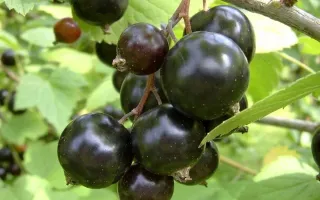
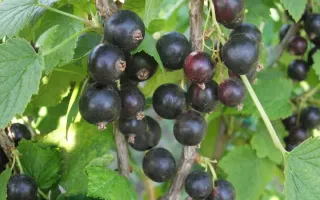
Berries weighing 0.8–1.3 g, on long pedicels, uniform in size, round, black, with thick skin, good taste, do not shed or lose market quality for more than 20 days after ripening. Inflorescences are long, bearing 712 berries. Chemical composition: dry matter — 20.8%, total sugars — 9.4%, free acids — 3.6%, ascorbic acid — 150.0–172.3 mg/100 g fresh weight.
Early-fruiting, self-fertile, versatile variety, suitable for industrial cultivation, but loses winter hardiness after mechanical berry harvesting; high yield, up to 2.9 kg per bush, easily propagated.
Advantages of the variety: medium-late maturing, escapes spring frosts, high-yielding, self-fertile.
Disadvantages of the variety: susceptible to bud mite and powdery mildew.
Crop & resistance
Crop
Specifications
| Type of Sort | |
|---|---|
| Catalog | Catalog → Currant |
Store offers
Prices are updated on loadLoading offers…
Aggregator catalog: prices are collected automatically from store websites, normalized by AI and converted at the current exchange rate. Before ordering, confirm the price and availability on the store's website. This block is not indexed by search engines — the data is loaded after the page opens.
Not yet комментариев. Be the first!
Alternatives
Currant saplings · similar varieties





See also
Often considered together with this variety


Recently viewed
Products you’ve viewed on this site
Reviews · 0