


SKU #69412
·
33 views
PAVLOVSKY 16
Clover
User rating
0 votes0% positive reviews
No ratings yet — be the first.
Vegetation Period
70-100
Flower Color
Red, Pink
Variety Characteristics
High protein content
Registration year
1981
About product

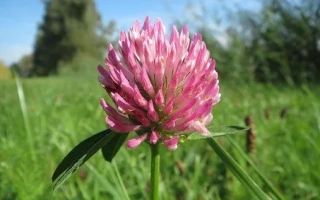
PAVLOVSKY 16 is a two-cut legume variety developed by individual-family selection from a hybrid population at the Oryol Research Institute of Agriculture. This variety is characterized by a medium number of internodes (9-10), sparsely pubescent dark green leaves, and medium-density inflorescences in the form of globose heads of dark red color with a pinkish hue. Seeds have a yellow-purple colorati…
Vegetation Period
70-100
Flower Color
Red, Pink
Variety Characteristics
High protein content
Registration year
1981
Description
PAVLOVSKY 16 is a two-cut legume variety developed by individual-family selection from a hybrid population at the Oryol Research Institute of Agriculture. This variety is characterized by a medium number of internodes (9-10), sparsely pubescent dark green leaves, and medium-density inflorescences in the form of globose heads of dark red color with a pinkish hue. Seeds have a yellow-purple coloration, a mass of 1000 seeds of about 1.9 g, and a hardness of up to 5%. The vegetation period of the variety varies from 74 to 106 days to the first cut and from 124 to 186 days to harvesting for seeds.
The PAVLOVSKY 16 variety was included in the State Register of Breeding Achievements in 1981 and is recommended for sowing in the Central climatic region of Russia, covering such regions as Bryansk, Vladimir, Ivanovo, Kaluga, Moscow, Ryazan, Smolensk, Tulsk, as well as the city of Moscow. In addition, the variety is allowed for use in a number of other regions, including Kaliningrad, Kostroma, Leningrad, Novgorod, Pskov, Tver, Yaroslavl, Voronezh, Kursk, Lipetsk, Oryol, and Tambov.
PAVLOVSKY 16 demonstrates a medium dry matter yield at the level of 77.7 c/ha with maximum indicators up to 123.7 c/ha, and seed yield reaches an average of 1.1 c/ha with maximum values up to 2.7 c/ha. In terms of protein content, the variety exceeds the standard variety Srednerussky, and protein collection is at a comparable level. The variety is susceptible to medium and severe brown spot damage and medium anthracnose damage, which corresponds to the level of standard varieties. Thanks to its characteristics and adaptation to the climatic conditions of the Central region, PAVLOVSKY 16 is a reliable choice for feed production and seed sowing.
The PAVLOVSKY 16 variety was included in the State Register of Breeding Achievements in 1981 and is recommended for sowing in the Central climatic region of Russia, covering such regions as Bryansk, Vladimir, Ivanovo, Kaluga, Moscow, Ryazan, Smolensk, Tulsk, as well as the city of Moscow. In addition, the variety is allowed for use in a number of other regions, including Kaliningrad, Kostroma, Leningrad, Novgorod, Pskov, Tver, Yaroslavl, Voronezh, Kursk, Lipetsk, Oryol, and Tambov.
PAVLOVSKY 16 demonstrates a medium dry matter yield at the level of 77.7 c/ha with maximum indicators up to 123.7 c/ha, and seed yield reaches an average of 1.1 c/ha with maximum values up to 2.7 c/ha. In terms of protein content, the variety exceeds the standard variety Srednerussky, and protein collection is at a comparable level. The variety is susceptible to medium and severe brown spot damage and medium anthracnose damage, which corresponds to the level of standard varieties. Thanks to its characteristics and adaptation to the climatic conditions of the Central region, PAVLOVSKY 16 is a reliable choice for feed production and seed sowing.
Crop & resistance
Crop
Disease resistance
Specifications
| Vegetation Period | 70-100 |
|---|---|
| Flower Color | |
| Variety Characteristics | |
| Registration year | 1981 |
| Catalog | Catalog → Clover |
| Legal data |
Show · 1
|
| Country | Russia |
Store offers
Prices are updated on loadLoading offers…
Aggregator catalog: prices are collected automatically from store websites, normalized by AI and converted at the current exchange rate. Before ordering, confirm the price and availability on the store's website. This block is not indexed by search engines — the data is loaded after the page opens.
Not yet комментариев. Be the first!




See also
Often considered together with this variety


Recently viewed
Products you’ve viewed on this site
Reviews · 0