

SKU #73774
·
75 views
URALTAU
Citron
GBPOU 'UFIMSKY LESOTEHNICHESKY TECHNICAL COLLEGE'User rating
0 votes0% positive reviews
No ratings yet — be the first.
Citrus Cultures
Citron
Fruit Shape
Extended
Fruit Color
Lemon
Registration year
2009
About product

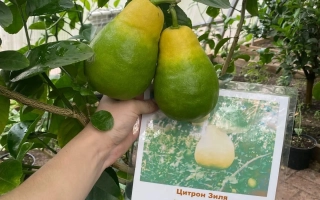
The citron variety "URALTAU" was discovered in 1992 by F.V. Sadykova in the greenhouse of the educational and experimental farm of the Ufa Forestry and Technical College. The tree reaches a height of 3–3.5 m and has a drooping crown; shoots are of medium thickness, arched, olive-gray in color, and hairless. Leaves are large, broadly oval, and serrated, giving the plant a characteristic appearance.…
Citrus Cultures
Citron
Fruit Shape
Extended
Fruit Color
Lemon
Registration year
2009
Description
The citron variety "URALTAU" was discovered in 1992 by F.V. Sadykova in the greenhouse of the educational and experimental farm of the Ufa Forestry and Technical College. The tree reaches a height of 3–3.5 m and has a drooping crown; shoots are of medium thickness, arched, olive-gray in color, and hairless. Leaves are large, broadly oval, and serrated, giving the plant a characteristic appearance.
The variety's flowers are bell-shaped, solitary or in inflorescences, pale pink, and fragrant. Fruits are large, weighing 260–500 g, elongated, lemon-yellow in color with a thick bumpy rind. The flesh is creamy, slightly greenish, juicy, and sweet-sour. Sugar content is 3.2–3.8%, acidity (mainly citric acid) is 3.6–3.9%, and vitamin C content is 33.4–37.4 mg.
Yield reaches 18.5 kg per tree. Fruits ripen in October; consumer readiness is observed from late October to February. The variety is grown in protected ground and was approved for use in Russia and RB in 2007. The Latin name is Citrus medica L., code 9252383, and the originator is GOU SPO Ufa Forestry and Technical College.
The variety's flowers are bell-shaped, solitary or in inflorescences, pale pink, and fragrant. Fruits are large, weighing 260–500 g, elongated, lemon-yellow in color with a thick bumpy rind. The flesh is creamy, slightly greenish, juicy, and sweet-sour. Sugar content is 3.2–3.8%, acidity (mainly citric acid) is 3.6–3.9%, and vitamin C content is 33.4–37.4 mg.
Yield reaches 18.5 kg per tree. Fruits ripen in October; consumer readiness is observed from late October to February. The variety is grown in protected ground and was approved for use in Russia and RB in 2007. The Latin name is Citrus medica L., code 9252383, and the originator is GOU SPO Ufa Forestry and Technical College.
Specifications hover over for a hint about the specification
| Citrus Cultures | |
|---|---|
|
Fruit Shape
Fruit Shape
Modern tomato varieties have a diverse fruit shape: flat, flat-round, round, oval, elongated-oval, pear-shaped, plum-shaped, cube-shaped, and cylindrical. On poorly fertile soils and under unfavorable growing conditions, tomato fruits may take on a more rounded shape. |
|
|
Fruit Color
Fruit Color
The fruit color of tomato varieties is influenced by the combination of skin and flesh color. Some varieties have transparent skin, others — yellow. When combined differently, the fruits can acquire quite diverse colors. The fruit color is affected by pigments (lycopene) and thei... |
|
| Registration year | 2009 |
| Catalog | Catalog → Citron |
| Manufacturer | GBPOU 'UFIMSKY LESOTEHNICHESKY TECHNICAL COLLEGE' |
| Legal data |
Show · 2
|
| Country | Russia |
Store offers
Prices are updated on loadLoading offers…
Aggregator catalog: prices are collected automatically from store websites, normalized by AI and converted at the current exchange rate. Before ordering, confirm the price and availability on the store's website. This block is not indexed by search engines — the data is loaded after the page opens.
Not yet комментариев. Be the first!
See also
Often considered together with this variety






Recently viewed
Products you’ve viewed on this site
Reviews · 0