


SKU #73785
·
73 views
WABI SABI
Crambe
User rating
0 votes0% positive reviews
No ratings yet — be the first.
Root vegetable shape
Cylindrical
Meat Color
White
Registration year
2024
About product

Wasabi «WABI SABI» – a perennial vegetable plant of the Brassicaceae family, valued for its rapid growth and high yield. Unlike horseradish, wasabi does not spread across the plot but produces large root vegetables already after the first season. The roots contain vitamins C, B, carotene, inulin, and pectin, making them beneficial for digestion and immunity. In folk medicine, wasabi is used as an…
Root vegetable shape
Cylindrical
Meat Color
White
Registration year
2024
Description
Wasabi «WABI SABI» – a perennial vegetable plant of the Brassicaceae family, valued for its rapid growth and high yield. Unlike horseradish, wasabi does not spread across the plot but produces large root vegetables already after the first season. The roots contain vitamins C, B, carotene, inulin, and pectin, making them beneficial for digestion and immunity. In folk medicine, wasabi is used as an antimicrobial agent and appetite stimulant.
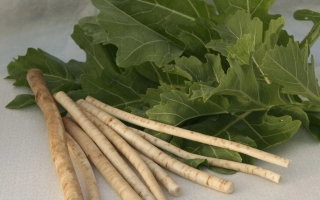
The «WABI SABI» variety is characterized by moderate height (about 41 cm) and a semi-erect leaf part, which is suitable for fresh consumption – as asparagus or salad. The root vegetables are cylindrical in shape, brown in color with a slightly rough surface, and the flesh is white-gray. The yield reaches 4 – 4.1 kg/m², and the plant is resistant to frost and drought, growing well on fertile loamy soils with good lighting.
In cooking, wasabi roots are used in salads, sauces, for pickling cucumbers, and as a spice. Thanks to its content of essential oils and phytoncides, the plant can also be used in cosmetics for cleansing the skin of acne. However, it should be avoided by people with gastrointestinal, liver, or kidney diseases.
The «WABI SABI» variety is characterized by moderate height (about 41 cm) and a semi-erect leaf part, which is suitable for fresh consumption – as asparagus or salad. The root vegetables are cylindrical in shape, brown in color with a slightly rough surface, and the flesh is white-gray. The yield reaches 4 – 4.1 kg/m², and the plant is resistant to frost and drought, growing well on fertile loamy soils with good lighting.
In cooking, wasabi roots are used in salads, sauces, for pickling cucumbers, and as a spice. Thanks to its content of essential oils and phytoncides, the plant can also be used in cosmetics for cleansing the skin of acne. However, it should be avoided by people with gastrointestinal, liver, or kidney diseases.
Specifications
| Root vegetable shape | |
|---|---|
| Meat Color | |
| Registration year | 2024 |
| Catalog | Catalog → Crambe |
| Legal data |
Show · 1
|
| Country | Russia |
Store offers
Prices are updated on loadLoading offers…
Aggregator catalog: prices are collected automatically from store websites, normalized by AI and converted at the current exchange rate. Before ordering, confirm the price and availability on the store's website. This block is not indexed by search engines — the data is loaded after the page opens.
Not yet комментариев. Be the first!
See also
Often considered together with this variety



Recently viewed
Products you’ve viewed on this site
Reviews · 0