


SKU #3363
·
472 views
Apple Isetskoe Pozdnee
Apple
User rating
0 votes0% positive reviews
No ratings yet — be the first.
Type of Sort
Winter Apple Variety
Store offers · 1 from 1 stores
Prices are updated on loadLoading offers…
Available at: Astrasad · Garshinka · xn-7sbgc2bcpfdq5cm-xn-p1ai
Aggregator catalog: prices are collected automatically from store websites, normalized by AI and converted at the current exchange rate. Before ordering, confirm the price and availability on the store's website. This block is not indexed by search engines — the data is loaded after the page opens.
About product

Winter variety from the Sverdlovsk Experimental Fruit Farm, obtained by crossing new Ural varieties 'Shchedraya' and 'Yantar'. Author: L. A. Kotov. Registered in the State Register of Selection Achievements, approved for use in the Volga-Vyatka and Ural regions. Widely cultivated and propagated in fruit nurseries of Sverdlovsk, Perm, Chelyabinsk, Kurgan regions, Udmurtia, and to a lesser extent i…
Type of Sort
Winter Apple Variety
Description
Winter variety from the Sverdlovsk Experimental Fruit Farm, obtained by crossing new Ural varieties 'Shchedraya' and 'Yantar'. Author: L. A. Kotov. Registered in the State Register of Selection Achievements, approved for use in the Volga-Vyatka and Ural regions. Widely cultivated and propagated in fruit nurseries of Sverdlovsk, Perm, Chelyabinsk, Kurgan regions, Udmurtia, and to a lesser extent in other subjects of the Volga-Vyatka region.
Medium-sized tree with a rounded crown. Main branches have brownish-gray, shiny bark, initially raised upward but eventually spread outward. Fruit set is concentrated on simple and complex rings.
Shoots of medium thickness, straight, round in cross-section, brown, densely hairy. Leaves are light green, matte, densely hairy, oval-egg-shaped, with a rounded base and pointed apex, finely serrated with a simple, fine-toothed margin, short petioles, and small, sickle-shaped stipules.
Flowers of medium size, cup-shaped, white with a pinkish tinge, buds rose-colored, stamens long, stigma long, arranged at the same level as the anthers.
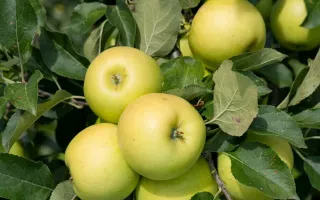
Fruits (see fig.) medium-small in size (mass 80–110 g), one-dimensional, high, rounded-conical shape. Ribbing is very weakly expressed. Surface smooth. Skin smooth, almost dry, becomes glossy and oily during storage. Color at harvest is greenish, turns greenish-yellow during storage, with a faint pink blush on a smaller portion of the surface. Calyx medium-sized, funnel-shaped, sometimes slightly rusty. Receptacle small, narrow, calyx closed. Subcalyx tube short, conical. Seed cavity large, heart-shaped. Seed chambers closed, axial cavity absent.
Flesh white, medium density, juicy, slightly acidic-sweet, aromatic, good taste, rated 4.2 points. Fruit appearance is good. Chemical composition: soluble solids — 13.1%, total sugars — 10.1%, titratable acids — 0.52%, ascorbic acid — 10.4 (up to 21.0 mg/100g in cool years), polyphenols (catechins) — 307.0 mg/100g.
Fruits remain firmly attached to the tree. Transportability is high. Storage and consumption period lasts 150 days. Fruits are consumed fresh and are suitable for processing: juices, compotes, jams, preserves, wine.
Self-sterile, requires cross-pollination, well-pollinated by other widely cultivated varieties.
Trees begin fruiting on the 5th year after grafting, with high and regular yields. 'Isetskoe Pоздneye' in the Ural region belongs to winter-hardy varieties. In wet years, it may be significantly affected by scab.
Advantages of the variety: winter hardiness, high yield, medium-large fruits of good taste suitable for winter storage.
Disadvantages of the variety: insufficient resistance to scab, oily skin of fruits in winter.
Video · 2 videos
Suggest a video →Crop & resistance
Crop
Specifications
| Type of Sort | |
|---|---|
| Catalog | Catalog → Apple |
Not yet комментариев. Be the first!
Alternatives
Apple saplings · similar varieties




See also
Often considered together with this variety



Recently viewed
Products you’ve viewed on this site
Reviews · 0