Medium-late ripening variety, developed at the All-Russian Research Institute of Fruit Growing named after I.V. Michurin from crossing the varieties Sirius and Black Prune. Breeders: K.D. Sergeeva, E.Yu. Koveshnikova. Under state variety testing since 2006.
Bush is vigorous, moderately spreading, medium density and branching. Growing shoots are thick, nearly straight, green, hairless, matte. Woody shoots are medium, light-colored. Shoot thorniness is weak. Thorns are single, medium length and thickness, straight, light, located perpendicular to the shoot and only in its lower part. Buds are elongated, small, with pointed tips, light-colored, hairless, slightly bent.
Leaves are large, dark green, matte or slightly shiny, hairless, smooth, leathery, convex. Teeth are medium, blunt, slightly curled. Main vein coloration absent. Leaf is three- to five-lobed, lobes with medium notches, central lobe slightly exceeds lateral ones, its lateral edges slightly rounded. Lateral lobes are medium length, wide, rounded, angle between lateral lobe veins is acute. Basal lobes absent or weakly developed, their veins spread out. Leaf base is straight or wedge-shaped, angle between leaf blade base and petiole is obtuse or straight. Petiole is medium length and thickness, with sparse glandular hairs, located at 45° angle to the shoot.
Flowers are large, pale. Sepals are large, pale, free, curled upward or lying horizontally. Inflorescence is predominantly two-flowered. Ovule is weakly hairy.
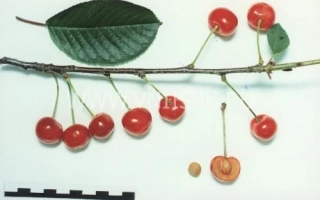
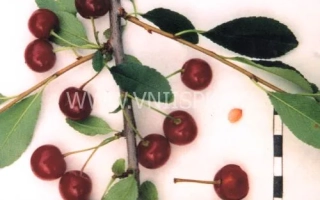
Berries are above average size (3.8-5.9 g), oval, dark red, nearly black at full ripening, hairless or with slight simple hairs, covered with waxy coating. Medium seed count. Skin is medium, with weak vein structure, veins weakly branched, lighter than main coloration. Taste is sour-sweet (4.4 points). Receptacle is medium, full, half-open. Berry stalk is medium length, cylindrical, thick, fleshy, with intense anthocyanin coloration at base. Chemical composition: dry soluble substances - 13.1%, total sugars - 8.7%, titratable acidity - 1.8%, ascorbic acid - 35.2-47.5 mg/100 g. Berries are of universal use.
Variety is winter-hardy, average yield 10.3-12.7 t/ha (3.1-3.8 kg/plant), resistant to American powdery mildew.
Advantages of the variety: high winter hardiness, resistance to American powdery mildew, weak shoot thorniness, good biochemical and technological berry qualities.
Disadvantages of the variety: unstable berry mass year to year.