Third-generation seedling, selected among Chamysh plants obtained from Far Eastern varieties. Sowing and cultivation of annual plants were conducted in the Altai Mountains, while further growth, selection (in 1989), and propagation were carried out in Khakassia. Authors: I.L. Baykalov and M.N. Matyunin, M.A. Lisavensky Institute of Fruit Growing. Undergoing state variety trials since 2001.
Medium-sized trees with wide, non-dense crowns. Leaves of medium size, elongated at the base, with blunt serrated edges. Petiole and central vein are reddish. Fruit buds form on clustered branches and first- and second-order annual shoots, blunt-tipped, growth-pointed. Flowers are large and pink.
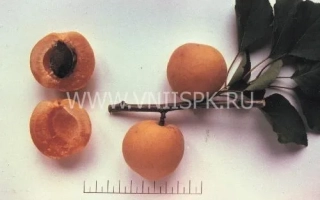
Fruits are large, 25-30 g, round with a small ridge and well-defined seam. In early August, on the sunny side, the fruit has a dark green coloration covered with a rough (non-glossy) hue. By mid-month, this coloration takes on a pink tint and later turns red, giving the fruit a very attractive appearance. Flesh is medium-firm and juicy, light-orange in color, with good flavor. Dry matter content: 13.7%, sugars: 7.1%, acids: 1.8%, vitamin C: 8.1 mg/100g, pectin: 0.57%.
Self-fertility is not high; good pollinators include Eastern Sayan, Abakan, Severyanin, and Siberian Baykalov.
Late maturation, 15-17 August. Yield of 10-year-old trees: 13-15 kg, maximum up to 47 kg. Flowering begins in mid-May. Cold resistance and resilience in snow-poor areas of southern East Siberia are high. In snowy regions, susceptible to sunscald and drying diseases. Fruit buds exhibit enhanced winter hardiness.
Recommended for testing in snow-poor areas of East Siberia.
Advantages of the variety: cold resistance, large fruits of good flavor.
Disadvantages: susceptibility to sunscald.