
Barley yellow dwarf virus
Polerovirus wydvgpv
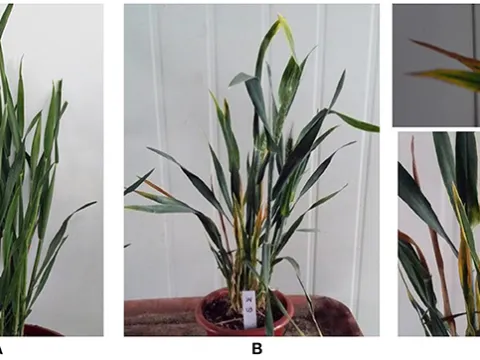
The first signs of Barley yellow dwarf virus infection typically appear as a distinctive yellowing or reddening of the leaf tips in young plants.
What the section contains
Barley yellow dwarf virus
Leaves exhibit colors ranging from bright yellow to intense orange or reddish-brown, depending heavily on the crop species and specific varietal characteristics.
Infected plants show significant stunting, resulting in a dwarfed, compact appearance due to shortened internodes and often increased tillering.
Affected fields frequently display a patchy distribution, with clear clusters of stunted, discolored plants standing out against the healthier surrounding crop.
The root system is usually poorly developed, leading to reduced nutrient and water uptake, which leaves the plant highly vulnerable to environmental stress.
The pathogen is the Barley yellow dwarf virus (BYDV), which is classified within the Polerovirus genus.
It acts as an obligate intracellular parasite that primarily attacks grasses and cereals, including barley, wheat, oats, and maize.
The virus is transmitted by various species of cereal aphids, such as the bird cherry-oat aphid, the grain aphid, and the corn leaf aphid.
Transmission occurs in a persistent manner: the aphid acquires the virus by feeding on infected phloem and remains an infective vector for the rest of its life.
The virus replicates and resides specifically in the phloem tissues, which disrupts the transport of photoassimilates and causes the classic symptoms of yellowing and stunting.
Mild winters and cool, moist spring conditions create optimal environments for the rapid reproduction and migration of aphid vectors.
Early planting of winter cereals often poses a higher risk of infection, as seedling emergence coincides with the peak activity of autumn aphid flights.
Wild grasses growing near agricultural fields serve as crucial reservoirs for the virus and provide a bridge for aphid survival during the summer months.
High population densities of aphid vectors, when moving from wild grassy areas to young crop fields, significantly increase the rate of virus spread.
Continuous cropping and the lack of proper crop rotation contribute to the buildup of the virus in the environment and facilitate long-term persistence in the field.
Barley yellow dwarf virus is widely considered one of the most economically devastating cereal diseases globally, frequently causing severe yield losses.
The primary damage results in significant reduction of grain weight, poor kernel development, and a substantial decrease in grain quality and test weight.
Infected plants exhibit reduced capacity for productive tillering and fail to develop robust spikes, leading to lower grain numbers per square meter.
Early-season infection is particularly destructive, as the systemic nature of the virus severely limits the plant's potential from its early growth stages.
Beyond direct yield loss, plants stressed by the virus are significantly more prone to secondary fungal infections and environmental damage, further compromising crop integrity.
The primary management strategy involves the application of insecticides to suppress aphid populations during critical periods of migration and colonization.
Adopting appropriate planting dates is a key agronomic practice to ensure that seedling emergence does not align with peak periods of aphid vector activity.
Effective management requires the elimination of cereal volunteer plants and weeds, which act as primary virus sources and shelters for aphid vectors.
The use of genetically resistant or tolerant crop varieties is recognized as the most effective and sustainable long-term solution for managing the disease.
Maintaining crop rotation and implementing spatial isolation between fields can help break the viral infection cycle and reduce overall disease pressure in a region.