
Barley yellow mosaic
Bymovirus hordei
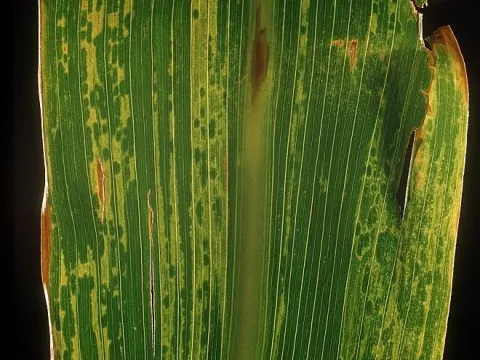
The most distinctive sign of barley yellow mosaic is the development of yellow or pale green mosaic patterns, streaks, and spots on the leaves of winter barley.
What the section contains
Barley yellow mosaic
Symptoms typically appear in early spring, starting on the lower leaves and progressing upwards as the virus spreads within the plant tissue.
Infected plants exhibit severe stunting and excessive tillering, which results in a bushy, deformed appearance rather than uniform vertical growth.
Under cool, wet conditions, the foliage may curl and turn necrotic, leading to premature leaf death and a significant reduction in the photosynthetic capacity of the crop.
Because these symptoms can mimic nutrient deficiencies or other physiological stress, laboratory analysis is required to confirm the presence of the Barley yellow mosaic virus (BaYMV).
The disease is caused by the Barley yellow mosaic virus (BaYMV), which is a member of the genus Bymovirus within the Potyviridae family.
This virus is an obligate parasite and cannot survive in the soil or crop debris for extended periods without its natural biological vector.
The virus is transmitted by the soil-borne plasmodiophorid protist Polymyxa graminis, which acts as the primary reservoir and vector.
The vector infects the root system of barley seedlings, where the virus is transferred into the plant cells during the early stages of development.
The resting spores of Polymyxa graminis can persist in the soil for several years, ensuring the virus remains present even in the absence of a host crop.
The development of the disease is highly dependent on the lifecycle of Polymyxa graminis, which thrives in moist and relatively cool soil environments.
Optimal infection occurs during the autumn months when soil temperatures range between 10°C and 15°C, coinciding with the germination of winter barley.
Continuous cropping of susceptible barley varieties facilitates the buildup of viral inoculum in the soil over successive growing seasons.
The dispersal of the vector and the associated virus occurs mechanically through the movement of infested soil by farm machinery, wind, or surface water runoff.
High soil moisture levels during the spring season often exacerbate the symptoms, as they promote the activity of the protist vector within the root zone.
Barley yellow mosaic is a highly destructive disease for winter barley production, capable of significantly reducing total grain yields.
The damage manifests as reduced plant vigor, a decrease in the number of productive tillers, and the formation of smaller, lower-quality grain spikes.
Infection compromises the winter hardiness of the crop, frequently resulting in patchy stands and plant mortality after severe winter weather conditions.
The combination of reduced biomass and poor grain filling negatively impacts the overall economic return of the harvested crop.
In regions with high disease pressure, farmers may experience yield losses exceeding 30–50%, forcing them to consider alternative crop rotations or resistant cultivars.
The most effective strategy for managing barley yellow mosaic is the cultivation of resistant or tolerant barley varieties developed through breeding programs.
Extending crop rotation intervals to at least 3–5 years between barley crops helps to diminish the population of Polymyxa graminis spores in the soil.
Adjusting sowing dates to avoid the peak infection window during the early autumn can help reduce the initial viral load in the field.
Sanitation practices, such as thoroughly cleaning farm machinery to remove infested soil before moving to clean fields, are vital to preventing disease spread.
There are currently no chemical treatments available to control the virus or its vector directly, making preventive agronomic management essential for disease suppression.