
Potato leafroll virus
Polerovirus pewbvyv
The causal agent of this disease is the Potato leafroll virus (PLRV), which is classified within the genus Polerovirus.
What the section contains
Potato leafroll virus
The virus consists of small, isometric particles containing a single-stranded RNA genome that is highly stable.
It is classified as a persistent (circulative) virus, meaning it must be ingested by an insect vector to be transmitted to healthy plants.
Unlike many other viruses, PLRV is not transmissible through mechanical contact or by simple sap rubbing between plants.
The primary inoculum sources for new infections include infected seed tubers and various wild hosts in the Solanaceae family.
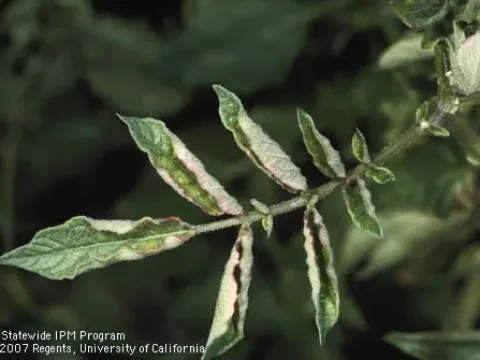
The hallmark symptom is the upward rolling of the leaflets of lower leaves, which eventually spreads to the entire plant.
Affected foliage becomes brittle, leathery, and often exhibits chlorosis or purplish discoloration along the margins.
Early season infection typically causes the youngest leaves to roll and remain stunted, leading to a compact plant appearance.
The tubers of heavily infected plants often show net necrosis, which manifests as a network of brown necrotic streaks in the flesh.
- Upward rolling of leaf margins
- Leathery texture of leaves
- Yellowing and purpling symptoms
- Net necrosis in tuber vascular tissue
The virus is disseminated by aphid vectors, most notably the green peach aphid (Myzus persicae) and the potato aphid (Macrosiphum euphorbiae).
Spread is heavily dependent on aphid population dynamics, which are favored by warm and dry weather conditions during the growing season.
Winged aphids facilitate the long-distance spread of the virus by moving between fields and infesting new host plants.
The length of time an aphid feeds on an infected plant is crucial for the efficient acquisition and subsequent transmission of the virus particles.
Weedy areas and neglected fields serve as reservoirs for both the virus and the aphid populations during the off-season.
PLRV infection significantly reduces the starch content and overall potato yield, often leading to losses between 50% and 80%.
The plants are stunted, and the tuber size is drastically reduced, making the harvest commercially unviable.
Infected tubers have a very poor emergence rate in the following season, causing yield gaps and production instability.
The presence of net necrosis makes tubers unmarketable and prone to rapid decay during storage.
Due to the systemic nature of the virus, there is no curative treatment for an infected plant, leading to total loss of that plant's productivity.
The primary control measure is the use of certified, virus-free seed potatoes produced in disease-indexed certification programs.
Effective management of aphid populations through timely applications of systemic insecticides is vital during the critical growth stages.
Rogueing, the process of identifying and removing symptomatic plants from the field, is essential to stop the chain of transmission.
Maintaining proper distance from commercial potato fields and controlling alternative weed hosts are recommended field practices.
Choosing resistant or tolerant potato varieties is a sustainable approach to mitigate the damage caused by the virus in endemic regions.