
Potato spindle tuber viroid
Pospiviroid fusituberis
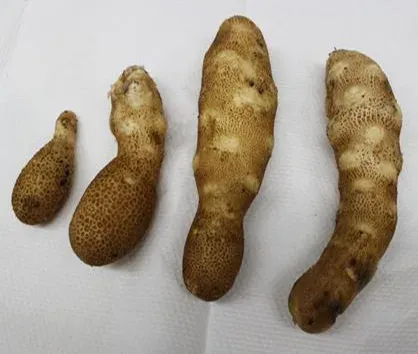
Description
Symptoms
The most distinctive symptom in potato tubers is their elongated, cylindrical, or pear-shaped appearance, often accompanied by prominent "eyes" and longitudinal cracking.
Above-ground, potato plants exhibit a stunted, upright habit with smaller, rugose, and chlorotic leaves. They often lose the typical lush appearance of healthy foliage.
In tomato plants, the disease causes severe distortion of the top leaves, which become curled and reduced in size. The plant often takes on a bushy, compact appearance.
Flowering is typically reduced in infected plants. In severe cases, blossoms may fail to develop or fall off prematurely, resulting in poor fruit set or deformed fruits.
Symptomless infections are common, especially in certain potato cultivars. These "hidden" carriers represent the highest risk for silent spread within a farm.
Pathogen
The disease is caused by the Potato spindle tuber viroid (PSTVd), the type species of the genus Pospiviroid. It consists of a single-stranded circular RNA molecule lacking a protein coat.
Unlike viruses, viroids do not encode proteins. They rely entirely on the host plant's RNA polymerase II to replicate within the nucleus of infected cells.
PSTVd is remarkably stable and can persist in dried plant tissue, on farm machinery, and on soil surfaces for extended periods, making it highly contagious.
The host range is primarily limited to the Solanaceae family, including potato, tomato, pepper, eggplant, and various ornamental species like petunias.
Once the viroid enters a plant, it moves systemically through the phloem to all parts of the organism, including the tubers, where it persists indefinitely.
Conditions for development
The viroid is primarily spread through mechanical transmission. Cutting tools, machinery, and even the clothes of workers can carry the pathogen from plant to plant.
Insects such as aphids, grasshoppers, and beetles can act as vectors, picking up the viroid while feeding on an infected plant and transmitting it to a healthy one.
Transmission can also occur through contact between healthy and infected root systems or foliage, especially in dense plant stands or during field operations.
The efficiency of transmission is significantly higher under conditions that favor mechanical contact, such as cultivation, weeding, and mechanical harvesting.
Environmental factors like high temperature and high humidity often promote faster symptom development and increase the mobility of insect vectors.
Why it matters
The economic impact is substantial, with significant yield reductions in potato tubers and fruit crops. In sensitive cultivars, losses can exceed 50%.
Tuber quality is severely compromised, rendering the harvest unmarketable due to shape deformities. Such tubers are often rejected by the processing and fresh produce sectors.
The storage life of infected potatoes is shorter compared to healthy ones. They are more susceptible to opportunistic pathogens and storage rots.
Seed potato production is severely affected. Because the viroid is tuber-borne, using infected stock perpetuates the disease into future generations.
Over time, the cumulative effect of the disease leads to total variety degeneration, forcing growers to discard infected stocks and seek fresh, certified materials.
Protection
The foundation of disease control is the use of high-quality, certified, viroid-free seed tubers. Testing programs are essential to ensure the health of the starting material.
Strict sanitation protocols are required for all tools. Knives used for cutting seed potatoes should be regularly disinfected with bleach or other virucidal agents.
Implementing a rigorous inspection program to identify and remove infected plants (roguing) during the growing season is critical to slowing the spread.
Managing insect populations is a secondary but important measure. Controlling aphids and other potential vectors helps reduce the risk of secondary infections.
Avoid planting potatoes near other susceptible solanaceous crops. Maintain a clean field environment by removing nightshade weeds that can act as alternate hosts.
Discussion
No discussions yet — be the first.