
Patatavirales
Patatavirales
Patatavirales is an order of viruses that primarily infects plants of the Solanaceae family, with potatoes being a significant host. These pathogens cause systemic infections that alter the plant’s fundamental metabolic processes.
What the section contains
Patatavirales
The virus is mainly transmitted through infected seed tubers, which makes it extremely challenging to eradicate from an agricultural operation once established. The virus spreads internally through the plant's vascular tissue.
One of the unique biological features of these viruses is their capacity to remain latent in tubers. This leads to asymptomatic carriage, where plants appear healthy despite hosting the pathogen.
At the cellular level, the virus utilizes the host’s machinery to replicate its genetic material, eventually causing physiological decay. Unlike fungal pathogens, these viruses cannot be managed through chemical fungicides.
Molecular diagnostics and advanced laboratory analysis are the primary tools for identifying these viruses, as traditional visual assessment is often insufficient for early-stage detection.
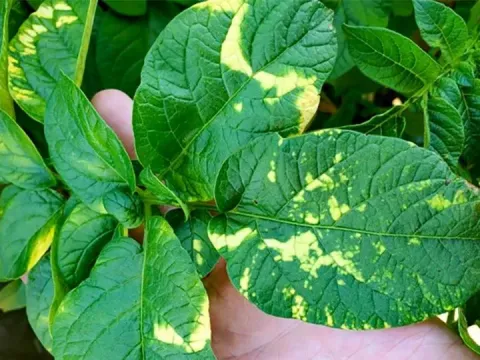
Common signs of infection include mosaic patterns on leaves, characterized by light and dark green discoloration. Leaf rolling is another frequent symptom, often occurring along the midrib.
Stunted growth is a hallmark of Patatavirales infection, with affected plants appearing significantly smaller, shorter, and less vigorous than their healthy counterparts in the same field.
Tubers from infected plants may show external deformities, such as surface cracking, skin necrosis, or significant irregularities in shape, making them unsuitable for market.
Chlorosis and premature yellowing of the foliage are common as the virus disrupts photosynthesis. This eventually leads to early senescence and a drastic reduction in total foliage volume.
- foliar mosaic patterns;
- stunted growth;
- leaf curling/rolling;
- tuber deformation;
- premature wilting.
The spread of the virus is highly dependent on insect vectors, particularly aphids, which transmit the pathogen while feeding on plant sap. High vector activity significantly increases the rate of infection.
Environmental conditions such as warm temperatures and optimal humidity levels accelerate both the activity of vectors and the rate of viral replication within the plant tissue.
Plant density plays a critical role in disease propagation. In overcrowded fields, contact between plant foliage allows for easier transmission of the virus, especially through mechanical damage.
Weed reservoirs near production sites often harbor the virus during the off-season. Insects migrate from these wild hosts to potato fields, initiating secondary infections.
Poor agricultural practices, such as failing to disinfect farm tools or saving seeds from already infected fields, are major contributors to the build-up of viral pressure in commercial potato production.
The presence of Patatavirales can lead to substantial yield losses, sometimes ranging from 30% to over 60%. This makes it a major concern for both commercial and small-scale farmers.
The cumulative effect of these viruses is known as variety degeneration. Over several planting cycles, a productive variety can lose its quality and yield potential entirely if infected stock is used.
Infected tubers exhibit poor storage life, leading to increased rotting and quality deterioration during transport and warehousing, which causes severe financial losses.
The nutritional value and culinary properties of the potatoes are also negatively affected, as the viral infection interferes with carbohydrate and starch accumulation.
The cost of managing the disease is high, as it requires constant monitoring, investment in virus-free seed stock, and rigorous pest management programs throughout the growing season.
The most effective strategy for managing these viruses is the exclusive use of certified, virus-free seed tubers. This ensures that the production cycle starts without primary inoculum.
Field sanitation is essential; this involves systematic removal of symptomatic plants (roguing) throughout the growing season to eliminate potential sources of further spread.
Implementing an integrated pest management program to control aphid and leafhopper populations is crucial to reducing the rate of secondary viral transmission between plants.
Ensuring spatial separation between new potato fields and areas populated with other solanaceous crops helps in preventing the initial migration of vectors into the crop.
Rigorous disinfection of machinery, tools, and storage areas is necessary to prevent the mechanical transfer of the virus, especially during the harvest and sorting processes.