
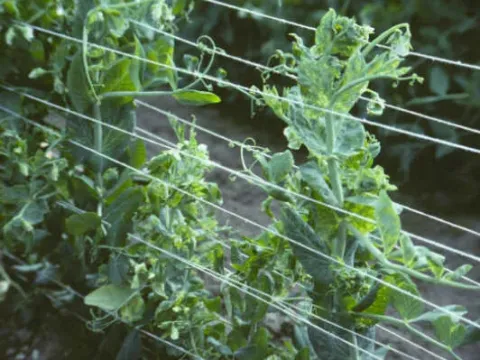
Pea enation mosaic virus
Enamovirus cvev
The causal agent of this disease is the Pea enation mosaic virus (PEMV), which is classified under the genus Enamovirus.
What the section contains
Pea enation mosaic virus
The virus particle consists of a single-stranded RNA genome and typically requires a helper virus, specifically a luteovirus, for its efficient transmission by aphids.
The pathogen is systemic, moving through the phloem of the host plant and disrupting its normal physiological and developmental functions.
Reservoirs for the virus include various perennial legumes and wild weed species that allow the virus to overwinter successfully.
The primary vector for the virus is the pea aphid, Acyrthosiphon pisum, which acquires the virus through persistent or circulative transmission modes.
Early symptoms appear as chlorotic spots on younger leaves, eventually developing into a noticeable mosaic or mottled pattern.
A distinctive hallmark of the infection is the formation of "enations," which are ridge-like or wing-like outgrowths on the undersides of the leaves.
Infected plants usually exhibit significant stunting, reduced height, and severe malformation of foliage compared to healthy individuals.
Flower and pod set is drastically reduced, leading to poor yield performance and distorted, underdeveloped pod structures.
Plants affected early in their life cycle may fail to produce viable seeds, showing yellowing and premature aging of the entire shoot system.
The spread of PEMV is heavily dependent on the migration patterns and population density of aphid vectors in the agricultural landscape.
Cool, humid spring conditions provide an optimal environment for aphids to multiply and move from perennial reservoirs to legume fields.
Proximity to perennial host plants like alfalfa or clover significantly increases the risk of early and severe viral infection in pea crops.
Weed management is critical, as many common field weeds serve as symptomless carriers of the virus throughout the growing season.
The physiological stress of the host plant can influence the speed of symptom development, though the virus is inherently aggressive once introduced.
Pea enation mosaic virus is a highly destructive pathogen capable of causing devastating yield losses ranging from 50% to over 80%.
The economic impact includes not only a reduction in grain quantity but also a decline in seed quality and viability for future planting.
The systemic nature of the disease severely hinders photosynthesis and carbon allocation, leading to weakened plant structures and lower overall productivity.
High levels of infection can render an entire field commercially unviable, necessitating total crop destruction or harvesting at a loss.
Increased expenditures on pest control programs represent a significant financial burden for farmers operating in high-risk regions.
Integrated Pest Management (IPM) focusing on the control of aphid vectors is the primary method for mitigating the spread of the virus.
Establishing adequate spatial isolation between new pea sowings and older perennial legume fields can significantly reduce initial infection rates.
Rigorous weed control both inside the field and along the borders is necessary to eliminate alternative hosts for the virus.
The cultivation of resistant or tolerant crop varieties remains the most effective and sustainable strategy for long-term virus management.
Crop rotation should be implemented to disrupt the viral cycle and decrease the presence of host tissues in the immediate environment.