
Pea enation mosaic virus
Enamovirus pemv
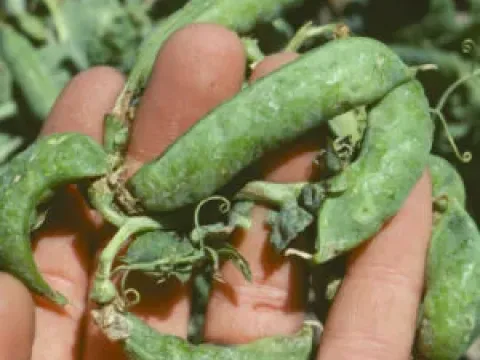
The most distinctive symptom of Pea enation mosaic virus (PEMV) is the appearance of translucent outgrowths, known as enations, on the underside of leaves and stipules, growing along the veins.
What the section contains
Pea enation mosaic virus
Infected pea plants exhibit stunted growth and a general chlorotic appearance. The leaves often show a mosaic pattern with intermingled light and dark green areas, frequently accompanied by leaf curling and deformation.
Plants infected at an early stage may show severe dwarfing and proliferation of axillary shoots. The stem growth is often restricted, giving the plant a bushy and distorted appearance rather than a typical upright structure.
Reproductive organs are significantly affected, leading to flower abortion and the development of small, deformed, and poorly filled pods. Consequently, seed set is drastically reduced both in number and size.
Symptoms can vary significantly depending on the specific strain of the virus and the cultivar of the host plant, making early diagnostic testing essential for professional field management.
The pathogen is the Pea enation mosaic virus (PEMV), the type member of the genus Enamovirus. It is a complex virus characterized by a bipartite genome contained within two separate particles.
Transmission occurs exclusively through aphid vectors, with the pea aphid (Acyrthosiphon pisum) being the most significant carrier. The virus is transmitted in a persistent, circulative, non-propagative manner.
Once the aphid feeds on an infected plant, the virus circulates within the insect's body for a latent period before it becomes transmissible to healthy plants. The virus does not replicate within the aphid vector.
The virus cannot be transmitted mechanically through sap or seed, meaning that long-distance spread is primarily mediated by the migration of viruliferous winged aphids.
The virus persists in overwintering perennial legumes, such as alfalfa or clover, which act as primary inoculum sources for annual pea crops in the following growing season.
The prevalence of the disease is strictly correlated with the population dynamics of the aphid vector. Warm and dry spring weather accelerates aphid reproduction and migration, significantly increasing the risk of early-season infection.
Proximity to perennial legume fields is a major factor driving infection cycles. When prevailing winds transport winged aphids from these reservoirs into young pea fields, rapid spread occurs across the crop.
High-density planting and favorable microclimates within the crop canopy can facilitate aphid movement between individual plants, leading to patches of infection that eventually coalesce.
The interaction between the virus, the vector, and the host plant is highly dynamic; therefore, the timing of aphid arrival relative to the phenological stage of the pea plant dictates the ultimate disease severity.
Stressed crops, whether due to drought or nutrient deficiency, may show more severe symptom expression, although the virus itself is the primary cause of the physiological decline.
PEMV causes severe economic losses, sometimes reaching total crop failure in highly susceptible fields. Yield losses are primarily attributed to reduced seed production and inferior seed quality.
Seeds harvested from heavily infected plants often show poor germination rates and reduced vigor, rendering them unsuitable for further agricultural use or seed production.
The physiological stress caused by the virus weakens the plants, making them more susceptible to secondary infections, such as root rot pathogens and various fungal diseases that further degrade crop health.
In green pea production for processing, the quality of the produce is compromised due to pod malformation and altered sugar content, significantly lowering the market value of the harvest.
The virus limits the potential of specific pea cultivars in endemic regions, necessitating reliance on resistant varieties or aggressive vector control to maintain agricultural viability.
The most effective strategy for managing PEMV is to maintain a significant spatial buffer between new pea crops and existing perennial legume fields to prevent early vector colonization.
Sanitation practices, including the aggressive management of weed reservoirs (such as wild vetches or clovers) around the perimeter of fields, help reduce the local aphid population and virus reservoir.
Chemical control of aphid populations using systemic insecticides is necessary during the early stages of plant development to interrupt the cycle of virus transmission.
Developing and deploying resistant or tolerant pea cultivars is the most sustainable approach to long-term disease management, as it reduces dependence on pesticide applications.
- Monitor aphid populations closely using yellow sticky traps to time insecticide applications.
- Practice crop rotation to minimize the build-up of local aphid populations.
- Use early sowing dates to ensure plants pass their most vulnerable developmental stages before peak aphid migration.