
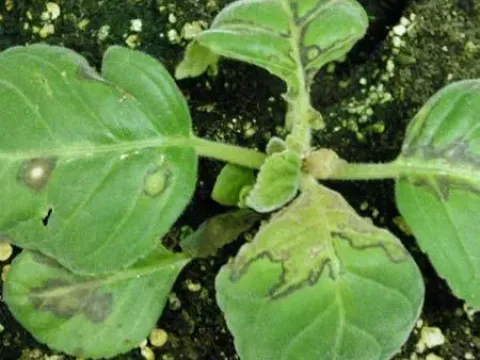
Tomato spotted wilt virus in Eustoma
Orthotospovirus eustomae
The causative agent of this disease is the Orthotospovirus eustomae, a virus belonging to the Tospoviridae family. It is a highly systemic pathogen that colonizes the plant's vascular tissues.
What the section contains
Tomato spotted wilt virus in Eustoma
The virus relies on insect vectors, primarily various species of thrips, including the Western flower thrips (Frankliniella occidentalis), for its transmission.
Transmission occurs through a persistent-propagative mechanism, meaning the insect remains infectious for its entire lifespan after ingesting the virus.
Once introduced into a greenhouse, the virus can spread rapidly due to the high mobility and rapid reproduction cycle of the thrips vectors.
The virus cannot be eradicated from the plant tissues once systemic infection has occurred, making it a significant concern for ornamental horticulture.
Initial symptoms on Eustoma leaves often include chlorotic spots, rings, or a mosaic pattern that disrupts the plant's aesthetic appeal.
As the disease progresses, infected plants exhibit severe leaf curling, stunted growth, and visible distortion of the stems and new shoots.
Dark necrotic streaks or lesions on the stems are characteristic of advanced stages, reflecting the systemic breakdown of plant tissues.
Flowers are frequently malformed or develop unusual necrotic markings and color breaking, which renders the blooms unmarketable.
Eventually, the plant may collapse and wither, a process that is often mistaken for root rot but does not respond to fungicidal treatments.
The development and spread of the virus are primarily dictated by the population dynamics of its thrips vectors, which thrive in warm environments.
Greenhouse temperatures ranging from 20°C to 25°C provide optimal conditions for both virus replication and rapid thrips breeding.
High relative humidity levels inside the greenhouse favor the survival and dispersal of the thrips population, thereby increasing the risk of virus transmission.
The presence of weeds in or around the greenhouse serves as a continuous reservoir for both the virus and its insect vectors.
Poor ventilation and crowded plant arrangements facilitate the movement of thrips from infected plants to healthy ones, spreading the pathogen throughout the crop.
The primary economic impact of this virus is the complete loss of crop quality, as infected plants cannot be recovered or sold.
Because there is no cure, the disease requires the total removal and destruction of symptomatic plants, often leading to significant financial losses for producers.
A single infected plant can become a source of inoculum for the entire greenhouse if thrips control measures are not immediately implemented.
The virus causes systemic weakening of the plant, which makes it more susceptible to opportunistic fungal and bacterial pathogens.
In large-scale operations, TSWV outbreaks can lead to total crop failure, threatening the economic viability of the flower production season.
Effective management focuses on aggressive thrips control and rigorous phytosanitary practices to exclude the virus from the growing environment.
Growers should focus on starting with clean, certified healthy plant material and preventing the entry of vectors into the greenhouse.
- Deploy blue sticky traps to monitor and reduce adult thrips populations.
- Regularly inspect plants for the earliest signs of the virus and immediately remove and incinerate symptomatic specimens.
- Implement a strict insect control program using systemic insecticides and, where appropriate, biological control agents.
- Maintain a weed-free zone around the greenhouse to eliminate alternative hosts for the virus.
- Sanitize all tools and equipment consistently to prevent mechanical transmission of the pathogen.
An integrated pest management (IPM) strategy is essential for mitigating the impact of the virus and maintaining the health of the Eustoma crop.