
Spinach begomovirus
Begomovirus spinaciae
The disease is caused by viruses belonging to the genus Begomovirus within the Geminiviridae family. These viruses are characterized by a single-stranded circular DNA genome enclosed in twin icosahedral capsids.
What the section contains
Spinach begomovirus
These viruses are obligate parasites that infect the phloem tissue of host plants. By hijacking the plant's metabolic pathways, they interfere with the translocation of nutrients, leading to systemic infection.
Transmission is primarily mediated by the whitefly Bemisia tabaci. The virus is acquired by the insect during feeding and is transmitted in a persistent, circulative manner, meaning the vector remains infectious for its entire lifespan.
The biology of the virus relies heavily on the movement and feeding behavior of its insect vectors. High mobility of whiteflies ensures the rapid spread of the virus across spinach fields, often initiating from weed reservoirs.
Viral particles are highly stable, which enhances their survival within the insect vector and in plant debris. This biological resilience makes managing the disease a significant challenge for modern agronomy.
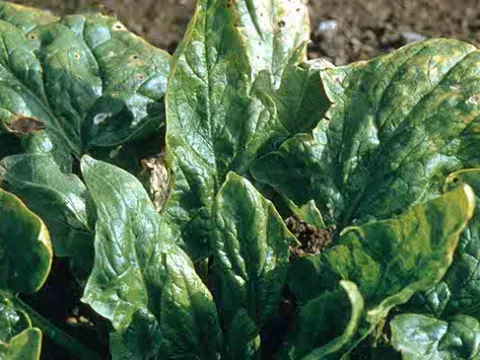
Typical symptoms include severe leaf curling, puckering, and deformation. Infected leaves often show chlorotic patterns or mosaic-like discolouration, reflecting the viral impact on photosynthetic efficiency.
Stunting is a hallmark of the infection. Infected spinach plants exhibit shortened internodes and form a dense, rosette-like structure, which prevents normal vegetative growth and reduces the size of the leaves.
The root system of infected plants is often poorly developed compared to healthy counterparts. This weakened state increases the plant's vulnerability to secondary soil-borne pathogens and environmental stresses.
Early signs may be subtle, appearing as a slight yellowing or clearing of the leaf veins. As the disease progresses, the distortion of the leaf lamina becomes more pronounced, eventually affecting the entire plant canopy.
- Severe leaf curling and crinkling
- Interveinal chlorosis
- Stunted plant growth
- Reduced leaf size
- Formation of stunted rosettes
The spread of the disease is highly correlated with warm and dry weather, which favors the rapid reproduction and migration of the whitefly vector. Outbreaks often occur during periods of low humidity and high temperatures.
Proximity to alternative host plants, such as various weeds or other susceptible vegetables, significantly increases the risk of infection. These plants act as reservoirs for the virus during the off-season.
Wind patterns facilitate the long-distance dispersal of viruliferous whiteflies. This makes even geographically isolated spinach crops susceptible to sudden influxes of the disease vector.
Poor agricultural practices, such as failure to manage weed populations around field borders, provide a constant source of inoculum. This is especially problematic in intensive vegetable production systems.
Plant stress, often caused by inadequate irrigation or nutrient imbalances, can exacerbate the susceptibility of the spinach crop. Maintaining optimal plant health is crucial to mitigating the impact of potential infections.
Spinach begomovirus causes significant economic losses by rendering the harvest unfit for fresh market sale. The severe deformation and discoloration lead to a complete loss of product quality.
In cases of early-season infection, the crop may suffer nearly total failure. The systemic nature of the virus means that even partially infected crops show drastically reduced yields and poor consumer appeal.
The damage is compounded by the lack of direct curative treatments for viral diseases in plants. Therefore, infected fields often represent a complete financial loss for the producer.
Widespread outbreaks can disrupt supply chains and force farmers to abandon infected fields, increasing the overall cost of production and requiring more intensive management strategies in subsequent seasons.
Persistent presence of the virus in the environment can necessitate a shift in planting schedules or crop rotation patterns to avoid peak whitefly activity, further complicating farm management.
The primary control strategy focuses on the management of whitefly populations. Systemic insecticides are frequently employed to reduce the density of vectors during the most critical growth stages of spinach.
Cultural practices, including the establishment of spatial isolation from known host plants and weed control, are essential for preventing the introduction of the virus into the field.
Using physical barriers such as insect-proof netting or row covers can effectively exclude whiteflies from the crops, providing a reliable protective layer during the early stages of development.
Rapid detection and immediate removal of symptomatic plants can help limit the spread of the virus within a field. Regular scouting using yellow sticky traps is recommended for early monitoring.
Research into resistant spinach cultivars is ongoing and represents the most sustainable solution. Breeding programs aim to incorporate resistance traits that prevent viral replication or reduce vector attractiveness.