
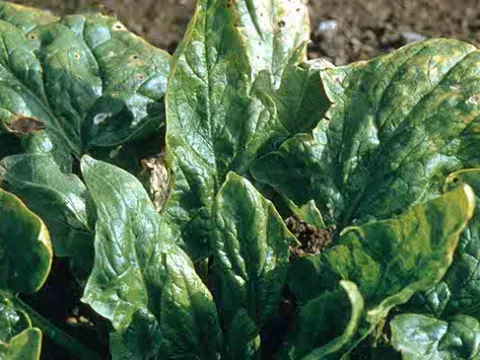
Spinach curly top
Curtovirus spinaciae
The disease is caused by the Curtovirus spinaciae virus, which belongs to the genus Curtovirus within the Geminiviridae family. It is a severe viral disease that systemically affects the plant's vascular tissue.
What the section contains
Spinach curly top
The virus has a wide host range, infecting numerous weed species that act as natural reservoirs for the disease. It survives in these hosts during off-seasons, ensuring the persistence of the pathogen in agricultural environments.
The beet leafhopper (Circulifer tenellus) is the primary vector of the virus. Once the insect feeds on an infected plant, it becomes a permanent carrier of the virus for the remainder of its life.
Transmission occurs when the leafhopper injects the virus into the plant's phloem during feeding. From there, the virus spreads rapidly throughout the entire plant, disrupting its metabolic pathways.
The virus's biology is intrinsically linked to the migration patterns of the beet leafhopper. Epidemics often occur when leafhopper populations migrate into spinach fields during hot, dry spells.
Early symptoms include a noticeable clearing of the veins on the youngest leaves. As the infection progresses, the leaves begin to curl inward, showing a distinct twisted appearance.
Plants become severely stunted with shortened internodes. The overall structure changes into a compact rosette of small, brittle, and highly distorted leaves.
The root system of infected plants often becomes brown, showing signs of vascular necrosis. The plant loses its vigor and exhibits significant growth inhibition compared to healthy specimens.
In chronic stages, the leaves may take on a yellow or reddish hue, indicating a disruption in the translocation of photosynthetic sugars from the leaves to the roots.
The most iconic symptom is the curling of the growing tip, from which the disease derives its name. Visible symptoms usually manifest within two weeks of initial inoculation.
The disease spread is heavily dependent on the population density of the beet leafhopper. Hot and dry environmental conditions provide the perfect setting for rapid transmission.
During drought, surrounding vegetation dries up, forcing leafhoppers to move into irrigated spinach fields. This movement triggers a sudden surge in virus transmission.
Poor weed management around the perimeter of the fields acts as a continuous source of infection. Weeds provide the breeding ground necessary for the vector to survive and multiply.
Temperatures exceeding 25°C accelerate the metabolism and feeding activity of leafhoppers, which increases the likelihood of successful virus inoculation in each plant contact.
While infection can occur at any growth stage, young seedlings are the most susceptible. Early-stage infection typically results in the total loss of the crop.
The primary economic impact is the total loss of marketability. Infected spinach, due to its severe deformation and stunted nature, is unsuitable for both fresh produce markets and processing.
Yield loss is significant, as the infection effectively halts plant development. The biomass of affected plants is reduced dramatically compared to healthy crops.
Viral infection negatively affects the sensory quality and nutritional value of the leaves. The texture becomes tough and fibrous, losing the crisp, tender quality expected by consumers.
Outbreaks can lead to complete field failure, necessitating immediate removal and destruction of infected crops to stop the spread to nearby healthy areas.
There are no chemical treatments available to cure a plant once it has been infected. Consequently, the disease is entirely managed through preventative measures.
The cornerstone of management is vector control. Implementing timely insecticide applications at the start of the season is critical to keeping leafhopper populations below economic thresholds.
Spatial isolation of spinach fields from other susceptible hosts, such as sugar beets, is highly recommended to minimize the risk of virus transmission from neighboring crops.
Maintaining a weed-free zone around the field edges is essential. By removing alternative hosts, you significantly reduce the local reservoir of both the virus and its insect vector.
Using row covers or agricultural fleece during the peak migration periods of leafhoppers can serve as an effective mechanical barrier, preventing insects from landing on the crop.
Regular monitoring using yellow sticky traps allows farmers to detect the presence of leafhoppers early, facilitating proactive management before the virus begins to spread.