
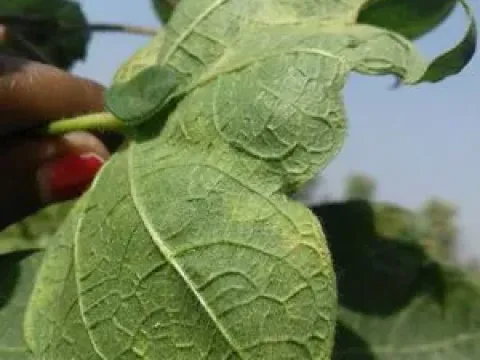
Cotton leaf curl virus
Begomovirus sidamusivi
The causative agent of the disease is the Sidamusivi virus, a member of the genus Begomovirus within the Geminiviridae family. This virus contains a single-stranded circular DNA genome and primarily infects species of the Malvaceae family.
What the section contains
Cotton leaf curl virus
In the field, the virus is transmitted in a persistent manner by the tobacco whitefly (Bemisia tabaci). The vector acquires the virus while feeding on infected plant tissues.
Once acquired, the virus circulates within the insect's body, enabling it to transmit the pathogen to healthy cotton plants throughout its remaining lifespan.
The movement of viruliferous whiteflies, often aided by wind currents, is the primary mechanism for the rapid spread of the disease across agricultural landscapes.
Alternative hosts, particularly various weed species, serve as essential reservoirs, allowing the virus to survive and persist during off-season periods.
The most characteristic signs of infection include severe leaf curling, distortion of the leaf lamina, and crinkling of leaf margins.
Yellowing or chlorosis often appears along the veins, significantly reducing the plant's photosynthetic efficiency and overall growth vigor.
Apical dominance may be disrupted, leading to stunted plants, shortened internodes, and a bushy appearance that distinguishes diseased plants from healthy ones.
Floral development is frequently impaired, resulting in bud shedding and a significant reduction in the number of mature bolls produced per plant.
Symptoms are typically more pronounced if the plant becomes infected at an early growth stage, leading to lasting structural damage to the cotton plant.
The incidence and spread of the virus are strongly correlated with the population density of its vector, the whitefly, which thrives in hot and dry climates.
Temperatures ranging from 25°C to 32°C create an ideal environment for the rapid reproduction of the whitefly and accelerated viral replication within plant tissues.
Irrigated fields often provide a stable microclimate that facilitates the survival of whitefly populations even during periods of extreme environmental stress.
Improper agronomic practices, such as excessive nitrogen fertilization, promote lush vegetative growth that attracts insects and increases the vulnerability of the crop.
Poor weed management on field margins acts as a critical factor, providing a continuous source of inoculum that can infect newly emerging cotton crops.
Cotton leaf curl virus is a highly destructive pathogen that poses a severe threat to the economic viability of cotton production on a global scale.
Infection leads to significant yield losses due to stunted plant growth, fruit abortion, and the failure of cotton bolls to develop properly.
Besides quantity, the quality of the harvested fiber is often compromised, which lowers its industrial value and marketability for textile manufacturers.
In severe outbreaks, entire fields may become non-productive, forcing farmers to abandon the crop or invest heavily in intensive control measures.
Furthermore, plants weakened by the virus are more susceptible to secondary infections and pest attacks, creating a complex management challenge for agronomists.
Integrated pest management (IPM) is essential, focusing primarily on controlling whitefly populations through the timely application of systemic insecticides.
Rigorous sanitation practices, including the eradication of host weeds in and around fields, are vital to eliminate viral reservoirs.
Maintaining spatial isolation between susceptible crops and older, potentially infected areas can significantly reduce the pressure of the virus.
The deployment of resistant or tolerant cotton cultivars remains the most effective and sustainable strategy for long-term disease management.
- Crop rotation with non-host plants.
- Monitoring whitefly population thresholds.
- Removing and destroying infected plant material.
- Using certified healthy seeds.
- Post-harvest field sanitation.