
Description
Symptoms
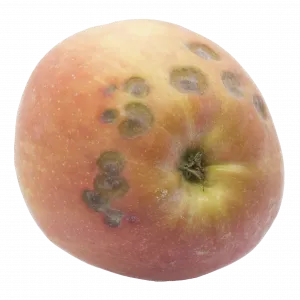
Cork spot initially manifests as small, slightly depressed, green or light-colored spots on the surface of the developing pear fruit.
As the disorder progresses, the underlying tissue within these spots turns brown, becomes spongy, and develops corky, necrotic lesions deep within the flesh.
The skin over the affected areas may become bumpy or distorted, giving the fruit an uneven and unattractive appearance that reduces marketability.
When the fruit is cut open, the flesh exhibits characteristic dry, brownish-red corky patches, primarily concentrated near the outer layers of the fruit.
While the fruit remains edible, its texture is severely compromised, becoming dry and flavorless, making it unsuitable for fresh consumption or storage.
Pathogen
Cork spot is not caused by infectious pathogens such as bacteria, fungi, or viruses; it is a physiological disorder associated with nutritional imbalance.
The primary culprit is a localized deficiency of calcium within the fruit tissues, which is essential for maintaining the integrity of cell walls.
Even if the soil contains sufficient calcium, its translocation to the fruit may be hindered by imbalances in other elements, particularly nitrogen and potassium.
The disorder occurs because calcium moves through the tree via the xylem, which is highly dependent on a consistent and continuous water supply.
Although sometimes associated with suspected virus presence, the condition remains primarily a result of metabolic failure related to element transport mechanisms.
Conditions for development
Excessive vegetative growth, often triggered by over-fertilization with nitrogen or heavy dormant pruning, forces calcium to move into shoots rather than fruits.
Fluctuating soil moisture levels, specifically drought stress followed by heavy irrigation, disrupt the transpiration stream necessary for calcium delivery.
High temperatures during the growing season increase transpiration, which can inadvertently limit the efficient movement of calcium into the developing pears.
Soil conditions such as high acidity or compaction can significantly inhibit the uptake of calcium by the tree's root system, leading to fruit deficiencies.
Cropping load plays a role; trees with very light crops often produce larger fruits that are more susceptible to cork spot due to the dilution effect of calcium.
Why it matters
The disorder causes significant financial loss because affected fruit cannot be sold as high-quality produce, resulting in downgrading for processing.
Cork-spotted pears have poor storage quality and are highly susceptible to secondary invaders and decay organisms during post-harvest handling.
The persistent nature of this disorder in orchards results in lower orchard profitability and increased costs for corrective management practices.
The necessity for frequent calcium sprays and intensive orchard management adds considerable labor and chemical expenses to the production cycle.
Poor fruit appearance and degraded internal texture lead to consumer dissatisfaction and a reduction in the overall value of the harvest.
Protection
The most effective strategy is the regular application of foliar calcium sprays during the fruit development stage to ensure direct nutrient uptake.
Managing tree vigor through controlled nitrogen application and balanced pruning helps prevent excessive shoot growth that competes for calcium.
Maintaining a consistent irrigation program is critical to ensure a steady water flow, which is the primary driver of calcium transport into the fruits.
Regular soil testing to monitor pH levels and nutrient availability allows for appropriate amendments, ensuring that calcium remains bioavailable to the roots.
- Implementation of summer pruning to improve light penetration and tree balance.
- Use of orchard floor management like mulching to stabilize soil moisture levels.
- Monitoring fruit calcium levels via tissue analysis during the growing season.
- Selecting rootstocks that are more efficient at nutrient uptake in specific soil types.
Pathogens and affected parts
Affects crops · 1
Discussion
No discussions yet — be the first.