
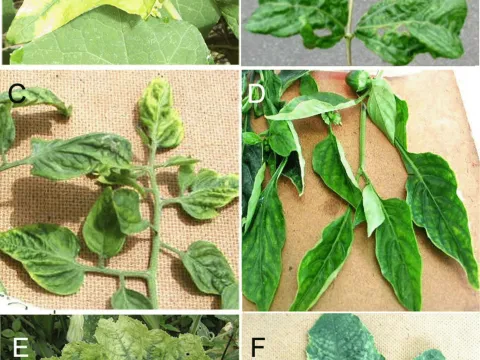
Cucumber chlorotic spot virus
Begomovirus chlorocucumis
The primary symptom is the development of chlorotic spots on the leaves, which often progress into a distinct mosaic pattern. Leaves may show yellowing between veins, leading to a mottled appearance.
What the section contains
Cucumber chlorotic spot virus
Affected plants exhibit stunted growth, with shortened internodes and deformed leaves. In severe cases, the foliage becomes crinkled and reduced in size, significantly impacting the plant's architecture.
Fruits from infected plants are often small, misformed, and show irregular blotches or bumpy surfaces. This loss of quality makes the produce unsalable for market purposes.
Symptoms are typically more pronounced on younger leaves, while older foliage might show more advanced chlorosis or necrosis as the virus progresses through the vascular system.
The characteristic «bunchy» or «stunted» look of the plant is often accompanied by an excessive proliferation of side shoots, giving the plant an uncharacteristic bushy appearance.
The disease is caused by Begomovirus chlorocucumis, a member of the Geminiviridae family. It contains a circular single-stranded DNA genome, typical of begomoviruses.
This virus primarily affects the Cucurbitaceae family, including cucumbers, squash, melons, and pumpkins. It is particularly problematic in intensive greenhouse production systems.
The virus persists in alternative host plants, particularly perennial weeds surrounding production areas, which act as primary reservoirs for the pathogen.
Transmission is mediated by the whitefly Bemisia tabaci in a circulative, non-propagative manner. The insect acquires the virus while feeding on infected sap and transmits it during subsequent feeding bouts.
Mechanical transmission is also possible through human activity, including pruning, training, and harvesting, where contaminated tools transfer viral particles to healthy tissues.
Virus outbreaks are highly correlated with the population dynamics of its vector, the whitefly. Warm temperatures ranging from 25°C to 30°C provide the optimal environment for rapid vector multiplication.
Poor greenhouse management, such as inadequate ventilation and high humidity, favors the survival and movement of whiteflies, accelerating the spread of the virus throughout the crop.
High planting density contributes to rapid disease dissemination, as the short distances between plants facilitate the quick movement of vectors or the easy transfer of virus via physical contact.
Outbreaks are most prevalent during peak growing seasons when environmental conditions are conducive to both the host plant and the insect vector.
The failure to implement rigorous sanitation measures in greenhouses ensures that the virus persists from one crop cycle to the next on residual crop debris.
The economic impact is primarily driven by a significant reduction in fruit quality and marketable yield. The plant's ability to perform photosynthesis is severely compromised.
Infected plants suffer from impaired nutrient transport, leading to physiological weakness and increased susceptibility to secondary opportunistic pathogens.
Early-stage infections can lead to catastrophic yield losses, as the virus stunts the overall vegetative development before the plant reaches its full fruit-bearing capacity.
Increased production costs are incurred due to intensive vector control programs and the need for frequent scouting and removal of symptomatic plant material.
Loss of plant vigor shortens the overall production lifespan of the crop, forcing early termination of the growing season in greenhouses.
Effective management begins with the use of certified, virus-free seeds and seedlings. Selecting resistant or tolerant varieties is a cornerstone of an integrated pest management strategy.
Controlling the whitefly population is essential. This involves the use of sticky traps, biological control agents (parasitoids), and timely application of specific insecticides.
- Sanitize all greenhouse structures, tools, and surfaces between growing cycles.
- Rogue out and destroy any plants displaying symptoms immediately to reduce the inoculum load.
- Maintain a weed-free perimeter to eliminate non-crop reservoirs of the virus.
- Use physical barriers like insect-proof netting on greenhouse vents to prevent vector entry.
- Rotate crops with non-cucurbit species to disrupt the viral reservoir cycle.
Training staff on proper hygiene practices, such as disinfecting tools between rows, significantly minimizes the risk of mechanical viral transmission.