
Crinivirus contagichlorosis
Crinivirus contagichlorosis
Description
Symptoms
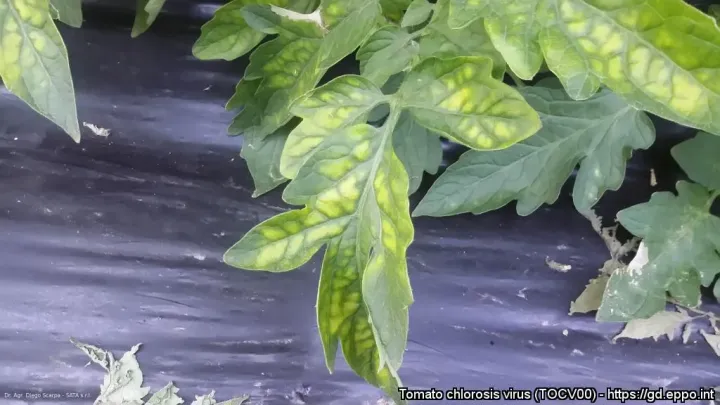
Symptoms typically begin with interveinal chlorosis on the lower and middle leaves. As the disease progresses, the chlorotic areas expand, while the veins remain distinctly green, creating a yellowing pattern.
The foliage often becomes brittle and may curl downward. Unlike many other viral diseases, severe leaf distortion, mosaic patterns, or stunting of the apical growth are not the most prominent features initially.
As the infection becomes systemic, older leaves may develop bronze patches, followed by necrosis and premature senescence. The plant's overall vigor declines significantly as the season progresses.
Growth is inhibited due to the impairment of nutrient distribution, leading to shortened internodes and a reduction in the total vegetative biomass of the plant.
- Interveinal chlorosis on older leaves
- Brittle and stiff leaf texture
- Premature yellowing and drop of basal leaves
- Significant decline in plant vigor
Pathogen
The causal agent of this disease is a virus belonging to the genus Crinivirus, family Closteroviridae. These viruses are characterized by filamentous particles containing single-stranded RNA.
The virus is strictly phloem-limited, meaning it resides and replicates within the plant's vascular tissue, disrupting the translocation of photoassimilates throughout the plant organism.
Criniviruses are not transmitted mechanically via contact or sap flow. Transmission is exclusively achieved through the feeding activity of specific insect vectors, primarily whiteflies such as Bemisia tabaci.
The transmission mode is semi-persistent, meaning the whitefly acquires the virus after feeding on an infected plant and can transmit it for several days before losing its ability to infect new hosts.
This virus has a broad host range, causing significant economic losses in various vegetable crops including tomatoes, cucumbers, and other members of the Solanaceae and Cucurbitaceae families.
Conditions for development
The spread of Crinivirus contagichlorosis is directly linked to the population density of whitefly vectors in the area. Warm and humid conditions significantly favor the rapid proliferation of these insects.
Greenhouses and protected agriculture environments are high-risk areas, as they provide stable microclimates that allow whitefly populations to persist throughout the year.
Weeds growing in or around the production area often serve as alternate hosts, acting as reservoirs for the virus during the off-season or between crop cycles.
The movement of winged adult whiteflies from infested weeds or nearby crops to healthy plants is the primary driver of viral outbreaks in commercial fields.
High temperatures can accelerate the metabolic rate of the vectors, leading to more frequent feeding cycles and, consequently, a higher rate of virus transmission within the crop.
Why it matters
The primary impact of the disease is the reduction of the plant's photosynthetic capacity, which leads to stunted growth and lower fruit yields. Plants become severely weakened and less productive.
Fruit quality is also negatively affected; infected plants often produce smaller, misshapen, or poorly ripened fruit that does not meet market standards for weight or taste.
By compromising the plant's metabolic health, the virus increases susceptibility to secondary pathogens, including opportunistic fungi and bacteria that further damage the crop.
In cases of severe infection, total crop failure is a significant risk, causing substantial financial losses for producers who rely on consistent harvest volumes.
The loss of marketability of the produce due to poor size and quality often results in the premature removal and destruction of the affected crop stands.
Protection
The most effective strategy is the management of the whitefly vector population. This includes the timely application of systemic and contact insecticides approved for use on specific crops.
Maintaining a strict sanitation protocol, including the thorough removal of weeds around greenhouses and field borders, is essential to eliminate viral reservoir sites.
Installing fine-mesh insect-proof screens on greenhouse vents can effectively prevent the entry of whitefly adults, significantly reducing the pressure from potential vectors.
Utilizing high-quality, virus-free transplants is a critical preventative measure, as early-stage infection is the most damaging to the crop's long-term development.
Regular monitoring using yellow sticky traps allows for early detection of whitefly migration, enabling producers to implement corrective measures before the virus spreads throughout the greenhouse.
Discussion
No discussions yet — be the first.