
Stewart's wilt
Stewart's wilt
Stewart's wilt is caused by the bacterium Pantoea stewartii subsp. stewartii, a Gram-negative pathogen belonging to the Enterobacteriaceae family.
What the section contains
Stewart's wilt
The pathogen is primarily transmitted by the corn flea beetle (Chaetocnema pulicaria), which serves as both a reservoir and vector during winter.
The bacteria can also be seed-borne, allowing for long-distance dissemination of the disease into previously unaffected agricultural areas.
Once inside the plant, the pathogen colonizes the xylem, producing extracellular polysaccharides that block water flow and cause systemic wilting.
Molecular detection techniques, such as PCR, are used for accurate diagnosis, as symptoms can sometimes mimic other environmental stresses or fungal diseases.
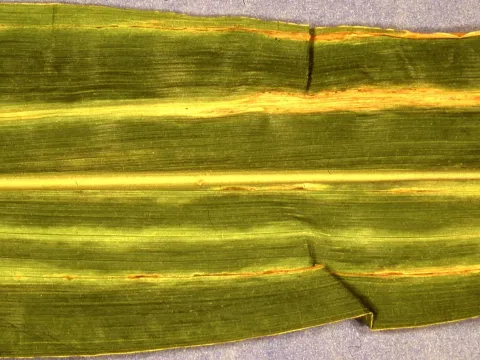
Early symptoms appear as pale green to yellow streaks with wavy margins running parallel to the leaf veins, which later turn necrotic and brown.
Systemic infection manifests as rapid wilting and chlorosis, especially under conditions of moisture stress, eventually leading to plant death.
A cross-section of the stalk near the base often reveals dark or discolored vascular bundles, which is a diagnostic sign of the bacterial colonization.
In highly susceptible corn varieties, severe stunting and tassel malformation are frequently observed in plants infected at an early growth stage.
- Water-soaked leaf streaks.
- Leaf wilting and necrosis.
- Discolored stalk vascular bundles.
- Stunting of young plants.
- Bacterial ooze from vascular tissues.
Mild winters are critical for the survival of the corn flea beetle, which determines the potential inoculum pressure in the following growing season.
Warm spring temperatures encourage the emergence and feeding activity of the insect vectors, leading to early transmission of the bacteria to corn seedlings.
Optimum growth temperatures for the bacterium range between 25°C and 30°C, coinciding with the rapid vegetative growth phase of corn.
Weed hosts surrounding the field can act as alternative reservoirs for the corn flea beetle, increasing the likelihood of pathogen introduction.
High relative humidity and warm weather patterns are conducive to both the multiplication of the bacteria and the activity of its insect vector.
Stewart's wilt is a economically devastating disease that can significantly reduce corn grain yield, particularly in highly susceptible hybrids.
Seedling blight caused by early infection can result in complete stand loss, necessitating costly replanting of entire corn fields.
In mature plants, the infection disrupts photosynthetic activity and grain fill, leading to poor kernel quality and overall yield decline.
Stalk rot associated with the disease makes plants brittle and prone to lodging, which severely complicates mechanical harvesting operations.
Due to its potential for international spread, the disease is regulated as a quarantine pest in many jurisdictions, limiting market access for growers.
Planting resistant or tolerant corn hybrids remains the primary and most sustainable approach to managing the disease in endemic areas.
Seed treatments with systemic insecticides are essential for protecting corn seedlings from the initial feeding of corn flea beetles during germination.
Monitoring flea beetle populations during the early vegetative stages allows for timely intervention with foliar insecticide applications when necessary.
Adherence to strict quarantine regulations for imported seed materials is vital to preventing the introduction of the pathogen into new regions.
Implementing proper cultural practices, such as choosing optimal planting dates, can help corn escape the peak activity periods of the insect vectors.