
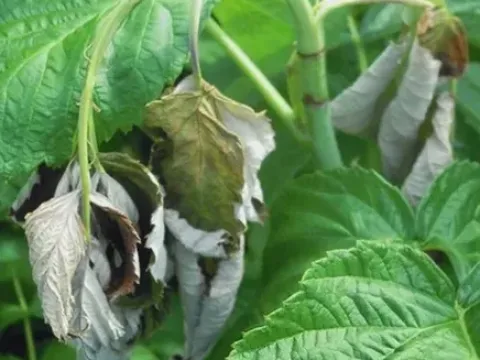
Raspberry downy mildew
Peronospora rubi
The causative agent of this disease is the oomycete Peronospora rubi. It is an obligate parasite that belongs to the downy mildew group and requires living host tissues to complete its life cycle.
What the section contains
Raspberry downy mildew
The pathogen's life cycle involves the formation of zoospores that can actively move in water films. The infection survives in contaminated plant debris, soil, and the tissues of perennial raspberry canes throughout the dormant season.
The fungus develops mycelium primarily in the intercellular spaces of plant tissue, utilizing haustoria to extract nutrients from host cells. This interaction leads to the gradual depletion of the plant's resources.
Infection spreads mainly through conidia, which are easily disseminated by wind or splashing water over significant distances. Upon landing on healthy leaves, the spores germinate quickly if conditions are favorable.
The pathogen is highly adaptable to various environmental conditions, making it a persistent threat in regions where raspberry cultivation is dense and climate conditions favor moisture accumulation.
The initial signs appear as chlorotic spots on the upper leaf surface, which may eventually turn yellow or reddish-brown. These lesions often exhibit undefined or irregular boundaries.
On the underside of the leaves, a distinct grayish or purplish fuzzy growth appears, which represents the fungus's sporulation. This feature is a primary diagnostic indicator of the infection.
As the disease advances, the infected areas undergo necrosis, leading to drying and crumbling of the leaf tissue. This results in the curling and premature drop of leaves, which compromises the plant's health.
In severe cases, the disease can affect the canes themselves, causing sunken spots that weaken the stems. This structural damage can reduce the overall vigor of the raspberry plant and impair its ability to withstand winter stress.
The overall impact manifests as stunted growth, poor cane development, and a significant decrease in berry production, ultimately threatening the economic viability of the affected raspberry plantation.
The development of the disease is strictly dependent on high relative humidity, typically 80-90%. Frequent rainfall, mist, and heavy morning dew create the perfect environment for zoospore germination.
The optimal temperature range for the pathogen's spread is between +15°C and +22°C. During these conditions, the incubation period shortens significantly, allowing for rapid disease cycles across the crop.
Overcrowded plantings prevent adequate air circulation, leading to prolonged moisture retention on the foliage. Lack of ventilation is one of the most critical factors driving the spread of downy mildew.
Poor cultural practices, such as failure to weed or remove excessive suckers, increase localized humidity around the bushes. This creates a microclimate that facilitates the penetration of the fungus into the plant.
Excessive nitrogen application stimulates the growth of tender, succulent tissues that are more susceptible to fungal infection. Maintaining a balanced nutrient program is essential to improve plant resilience.
The primary damage caused by downy mildew is the premature shedding of leaves, which deprives the plant of the energy reserves necessary for winter survival and spring regrowth.
Reduced photosynthetic capacity directly impacts the development of fruit buds for the following year. Consequently, yields decrease, and the resulting berries are often smaller and of poorer quality.
Plants weakened by the infection become highly susceptible to secondary pathogens and winter damage, often leading to significant cane dieback or total plant loss during harsh winters.
For commercial growers, this disease poses a significant risk, as the infection is easily transported via nursery stock, leading to rapid contamination across new planting sites.
The economic impact involves both the cost of fungicide applications and the loss of marketable berries, highlighting the necessity of integrated pest management for long-term production success.
Effective control relies on rigorous cultural practices: using certified healthy planting material, thinning canes to ensure proper aeration, and prompt removal of infected plant parts.
During autumn, it is essential to collect and destroy all fallen leaves and plant debris to eliminate the primary sources of overwintering inoculum for the next growing season.
Preventive measures include the application of copper-based contact fungicides or other protective agents that inhibit spore germination on the leaf surface during humid periods.
- Maintain proper spacing between raspberry rows.
- Avoid overhead irrigation to minimize leaf wetness duration.
- Monitor plantations regularly for early symptoms.
- Apply systemic fungicides when environmental conditions favor disease.
In cases of significant outbreaks, systemic fungicides should be employed to penetrate plant tissues, suppress existing mycelial growth, and break the life cycle of the pathogen effectively.