
Raspberry slime mold
Tubifera ferruginosa
Description
Symptoms
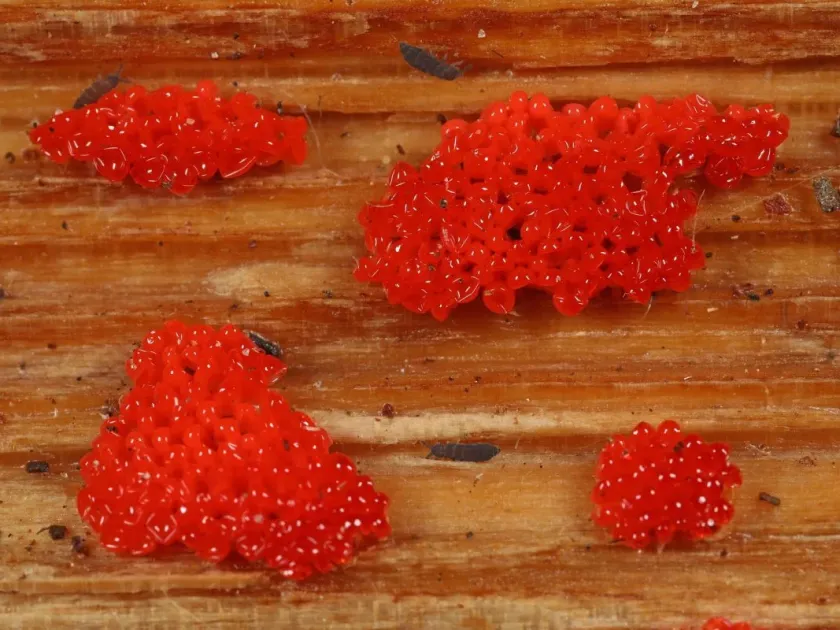
Tubifera ferruginosa appears as compact, bubble-like structures resembling a cluster of tiny eggs or berries. Initially, these clusters exhibit a vibrant pink or reddish hue, making them highly visible on decaying wood or plant debris.
As the sporangia mature, they darken, transitioning to a rusty-brown or dark-brown color. The physical structure resembles a coral-like formation or a dense arrangement of minute columns pressed tightly together within a single sporophore.
When mechanically disturbed, mature fruiting bodies are fragile and easily collapse, releasing a significant amount of dry, brown spore dust. This characteristic is a key visual marker for identifying this organism and distinguishing it from fungal infections.
On affected areas of plants or wooden substrates, there is typically no evidence of deep tissue decay caused directly by this organism. Instead, it utilizes the surface primarily as a physical support for its life cycle.
These clusters are most commonly found at the base of tree trunks, on fallen branches, stumps, or on damp organic litter surrounding cultivated plants. They rarely cover living foliage, preferring dead organic matter.
Pathogen
The causative agent is a myxomycete (slime mold) known as Tubifera ferruginosa. It is important to note that this is not a typical plant-pathogenic fungus but a eukaryotic organism that moves in its plasmodial stage to feed on bacteria and spores of other microorganisms.
Biologically, this organism belongs to the group of myxogastrid slime molds. Its life cycle involves an amoeboid plasmodium stage, which converts into spore-bearing structures under unfavorable environmental conditions or when seeking a suitable location for reproduction.
The pathogen spreads primarily via spores, which are transported by air currents over significant distances. Upon landing in a moist environment, the spores germinate, producing zoospores that initiate a new life cycle.
Since this is not a classic phytopathogen, it does not penetrate living plant cells to feed on sap or tissues. It is classified as a saprotroph that relies on decaying organic matter for survival.
The genetic diversity of the species allows it to adapt to various types of wood, including both coniferous and deciduous species, explaining its widespread distribution across gardens and forest areas.
Conditions for development
High humidity of both the air and the substrate is the critical factor for the development of Tubifera ferruginosa. Intense proliferation is typically observed during periods of prolonged rain, fog, or in conditions of excessive irrigation.
The optimal temperature for active plasmodial growth ranges from 15 to 25 degrees Celsius. Cooler temperatures slow down the life cycle, while dry air leads to rapid dehydration and prompts the transition to the sporulation stage.
The presence of abundant decaying plant residue or waterlogged mulch creates an ideal microclimate. In such environments, the slime mold finds a sufficient supply of nutrients in the form of associated bacterial microflora.
Crowded plantings that lack proper aeration contribute to moisture retention in the root zone. This becomes a trigger for the mass appearance of slime mold fruiting bodies on the soil surface or plant stems.
The absence of direct sunlight and UV radiation also favors the development of the mold, as it is sensitive to intense solar exposure and the overheating of the substrate surface.
Why it matters
This slime mold causes no direct harm to healthy cultivated plants because it does not act as a parasite on living tissues. However, its presence serves as a warning of significant agrotechnical issues, such as poor drainage and inadequate ventilation.
The secondary risk is that dense colonies of slime mold can physically block oxygen exchange at the bark or soil surface. This can create stress conditions for young seedlings and weakened plant specimens.
When spreading over ornamental parts of plants, the colonies can spoil their aesthetic appearance, which is critical for nurseries and landscape design. This effectively reduces the market value of the products.
Massive proliferation of slime molds often indicates ongoing rot processes in the substrate, which may be accompanied by the development of harmful secondary pathogenic fungi. These secondary fungi are the ones that pose a real threat to roots and stems.
The presence of slime mold in greenhouses requires attention because the high humidity that supports it also triggers the development of root rots, late blight, and other dangerous plant diseases.
Protection
The primary control method is the optimization of the water regime in the growing area. It is essential to ensure proper soil drainage and avoid excessive watering that leads to waterlogging of the topsoil layer.
Regular garden sanitation is the key to prevention. Removing rotting stumps, fallen leaves, and decaying wood eliminates the nutrient base required for the successful development and reproduction of the myxomycete.
It is important to follow proper spacing recommendations, ensuring good airflow for the plants. Thinning the canopy and regular soil cultivation help the surface layer dry out quickly, which is detrimental to the plasmodium.
If colonies are detected, they can be carefully collected mechanically, taking care to prevent spore dispersal in the air. The affected area can be treated with broad-spectrum fungicides, though this is not always necessary.
Using mulching materials that do not retain excess moisture (such as dry bark or landscape fabric) helps reduce the likelihood of slime mold compared to using hay or organic matter prone to rapid decay.
Discussion
No discussions yet — be the first.