
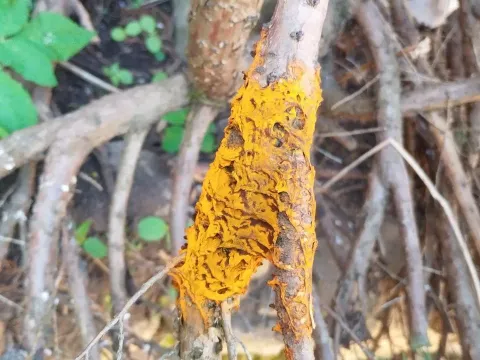
Juniper rust
Gymnosporangium unicorne
The causative agent of the disease is a heteroecious rust fungus, Gymnosporangium unicorne (often associated with Gymnosporangium sabinae). It is an obligate parasite that requires two hosts to complete its complex life cycle: juniper and members of the Rosaceae family, primarily pear trees.
What the section contains
Juniper rust
On conifers, the fungus develops over several years, colonizing the bark and wood tissues. In the spring, the infected areas develop aecia, which release spores that infect the secondary host, the pear tree. On the pear, the fungus forms pycnia and aecia on the leaves, completing its cycle.
The infection persists as mycelium within the juniper tissues, which serves as a long-term reservoir for the disease. Unlike annual fungi, this pathogen can live inside the plant for many years, gradually depleting its energy reserves.
The disease affects various juniper species, particularly the Savin and Eastern Red Cedar, as well as pear, apple, quince, and hawthorn trees. This interaction creates a dangerous biological chain where the juniper acts as a perpetual source of spores for fruit orchards.
A biological feature of this fungus is its high adaptability to environmental conditions. Effective control requires a systematic approach, as managing only one type of host plant is rarely sufficient to eliminate the pathogen from a garden.
The first symptoms on juniper appear in spring as swellings, galls, and growths on branches or trunks. During periods of high humidity, the bark ruptures, and bright orange or brownish gelatinous structures emerge.
In dry weather, these galls shrink and darken, becoming almost black, but they rehydrate and swell again when it rains. The localized mycelial activity causes the bark to crack, leading to deep wounds and eventual deformation or dieback of the shoots.
On the intermediate host, the pear, symptoms appear in summer as circular reddish-orange spots with small black dots on the upper leaf surface. By late summer, cone-shaped projections develop on the underside of the leaf, releasing spores that spread to other plants.
The health of the infected plant declines rapidly: needles yellow, branches lose their luster and eventually wither. Severe infection disrupts metabolic processes, particularly photosynthesis, weakening the tree significantly.
- Appearance of orange gelatinous galls on branches.
- Cracking bark and distorted young shoots.
- Rusty spots on pear leaves.
- Premature needle drop and leaf fall.
- Dieback of branch tips and general loss of vigor.
The development of juniper rust is directly linked to high humidity and moderate temperatures. Frequent rains, fog, and heavy dew in spring create perfect conditions for spore germination and long-distance dispersal by the wind.
The infection spreads from juniper to fruit trees, typically within a radius of 500 meters. However, strong winds can carry the spores for several kilometers, potentially infecting neighboring gardens.
The proximity of juniper and pear trees is the most critical risk factor. The closer these two hosts are planted to each other, the higher the infection intensity and the speed at which the disease spreads throughout the growing season.
Winter thaws and a damp early spring promote the activation of the mycelium inside the plant tissues. Lack of proper airflow in dense plantings also helps retain moisture, which triggers more frequent and intense spore production.
Garden management and tree health play a significant role. Weakened or poorly ventilated trees are much more susceptible to infection compared to vigorous, well-maintained specimens with a strong immune response.
The primary damage involves the suppression of growth and a significant reduction in the aesthetic value of juniper plantings. Prolonged infection causes the plant to lose its natural shape and density, resulting in stunted and unsightly specimens.
On fruit trees, particularly pears, rust causes premature leaf drop, which drastically reduces fruit yield and quality. Severely infected trees also show decreased winter hardiness, making them more vulnerable to frost damage.
Deep necrosis in the bark of juniper can lead to the death of major limbs or the entire plant. As the fungus spreads, it blocks the transport of nutrients, inevitably leading to the gradual decline of the entire canopy.
Economic losses for gardeners and nurseries stem from the constant need for fungicide applications and labor-intensive sanitation efforts. Neglecting the disease leads to the expansion of infection foci, threatening the entire plant collection.
Beyond physical damage, an infected garden loses its visual appeal, and the owner must invest significant time and resources into restoring the biological health of the ecosystem.
The primary preventative measure is spatial isolation: avoid planting junipers and pears in close proximity to one another. If they must exist in the same garden, monitor both plant types closely for early symptoms.
Regular sanitation pruning is essential: remove and burn all juniper branches showing signs of galls or swellings. Disinfect pruning tools and seal any wounds on the plant with a suitable wound dressing or copper-based paste.
In spring, before bud break and during the leaf-opening phase, apply preventative fungicide sprays containing copper (e.g., Bordeaux mixture) to protect vulnerable tissues.
During the growing season, utilize systemic fungicides, specifically those from the triazole or strobilurin families. Rotate different active ingredients to prevent the pathogen from developing resistance to the treatments.
Comprehensive care, including balanced fertilization, adequate irrigation, and soil management, strengthens the plant's natural immunity, helping it withstand initial infection stages more effectively.