

Disease
Especially harmful
Downy mildew of spinach
Peronospora effusa
Description
Symptoms
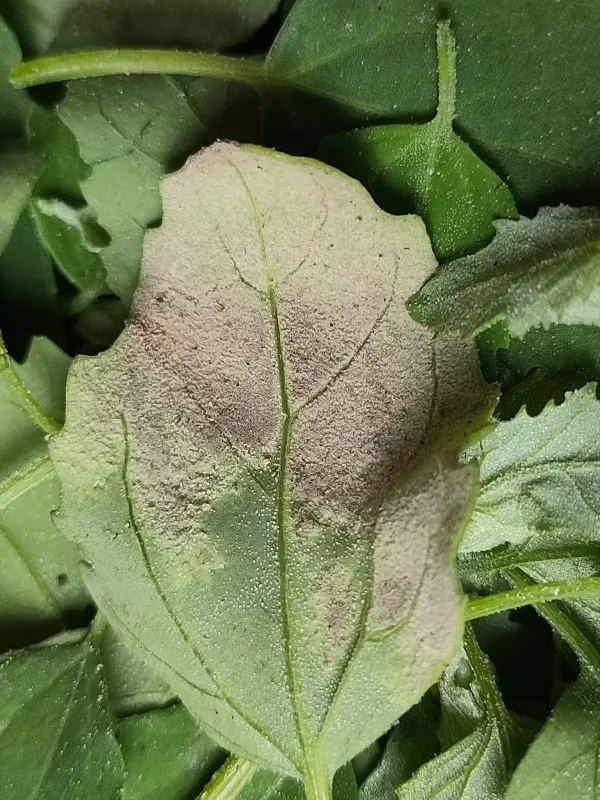
The primary symptom of downy mildew is the appearance of chlorotic, yellow-to-pale green spots on the upper leaf surface. These spots are often bounded by the leaf veins, giving them an angular appearance.
On the underside of these yellow spots, a distinct grey or violet-hued fungal growth becomes visible. This fuzz represents the sporangiophores and sporangia of the fungus, which are the reproductive structures.
As the infection progresses, the yellow spots eventually turn necrotic and brown. In severe cases, the entire leaf may collapse, turn yellow, and wither, making the plant look scorched.
The symptoms typically start on the older, lower leaves of the plant, as these leaves maintain higher humidity levels and are closer to the soil surface. From there, the infection spreads upward.
Diagnostic field identification is usually straightforward due to the presence of the characteristic underside growth, which distinguishes it from many other leaf spot diseases affecting spinach crops.
Pathogen
The pathogen responsible for this disease is the oomycete Peronospora effusa. It is a highly specialized, obligate parasite that specifically attacks spinach and a few other closely related species within the Amaranthaceae family.
This pathogen survives in the soil as oospores, which can remain viable for several years. It is also known to be seed-borne, meaning that infected seeds can introduce the disease into previously healthy fields.
The lifecycle of the pathogen involves the production of sporangia, which are dispersed by wind or splashing water. When they land on susceptible leaves in favorable conditions, they germinate and penetrate the tissue through the stomata.
Peronospora effusa is characterized by high genetic variability, leading to the emergence of new physiological races. This dynamic nature forces growers to constantly look for new resistant varieties as older ones lose their effectiveness.
Effective management requires understanding the pathogen's reliance on specific environmental factors. Because it is an obligate parasite, it requires living plant tissue to complete its reproductive cycle.
Conditions for development
High relative humidity, typically above 90%, is the primary environmental driver for downy mildew development. Free moisture on the foliage, such as dew or rain, is essential for the germination of spores.
The disease thrives in cool to moderate temperatures, with an optimal range between 10°C and 20°C. In these conditions, the incubation period can be very short, leading to rapid spread throughout the field.
Densely planted fields are highly susceptible because the lack of air circulation keeps foliage wet for longer periods after rainfall or irrigation. This creates a perfect microclimate for the pathogen.
Over-fertilization with nitrogen can encourage rapid, succulent growth that is more easily penetrated by the pathogen. Balanced nutrition is therefore a key component in maintaining plant health and resistance.
Poor drainage and low-lying field areas where water tends to pool often act as the initial epicenters for disease outbreaks. Proper field management and land leveling can mitigate these risks.
Why it matters
Downy mildew is arguably the most economically significant disease of spinach globally. It can cause total crop loss if conditions are ideal for the pathogen, rendering the produce entirely unmarketable.
Even if the damage is not 100%, the aesthetic value of the spinach is severely reduced due to lesions and necrotic spots. This makes the product unsuitable for the fresh-cut or retail markets.
The disease drastically reduces photosynthetic efficiency, which directly stunts plant growth and reduces overall yields. This results in significant financial losses for the farming operation.
Infected spinach has a very poor post-harvest shelf life. The high humidity required for the disease often leads to secondary soft rots in shipping containers, leading to rejection at the wholesale level.
The continuous need for intensive fungicide applications or the costs associated with plowing down a failed crop add significant economic pressure to the production cycle.
Protection
The most sustainable strategy is the use of resistant spinach varieties. Growers should work closely with seed suppliers to select hybrids that offer protection against the specific races of Peronospora effusa known to be present in their region.
Cultural practices are essential: prioritize field drainage, manage planting density to improve airflow, and eliminate weed hosts that could serve as a bridge for the pathogen between growing seasons.
Irrigation management is critical. Switching from overhead sprinklers to drip irrigation significantly reduces leaf wetness and, consequently, the infection rate of downy mildew.
Chemical control can be effective if timed correctly. Fungicides should be applied preventively or at the very first signs of symptoms. Always adhere strictly to the pre-harvest interval (PHI) due to the short harvest cycle of spinach.
Sanitation is vital. Post-harvest, all debris must be incorporated into the soil or removed. Rotating with non-host crops and maintaining a break in spinach cultivation help lower the inoculum density in the field.
Content graph
Connections · Downy mildew of spinach
Most often together:
Marketplace
Products · 9



Community
Discussion
No discussions yet — be the first.