
Sudden Death Syndrome of Soybean
Fusarium virguliforme
The causative agent of this disease is the soil-borne fungus Fusarium virguliforme. It is a persistent pathogen capable of surviving in the soil and crop residues for many years, making it a challenging threat to agricultural systems.
What the section contains
Sudden Death Syndrome of Soybean
The fungus primarily infects the root system of soybean plants. By colonizing roots early in the growing season, it compromises the plant's vascular integrity, effectively preventing the uptake and translocation of essential water and nutrients.
A distinctive feature of Fusarium virguliforme is the production of toxins that are transported throughout the soybean plant. These toxins are responsible for the severe foliar symptoms that appear later in the season, even when the fungus itself is restricted to the root system.
The pathogen forms micro-sclerotia, which are resilient survival structures. These allow the fungus to endure unfavorable environmental conditions, ensuring its presence in the field even after long intervals between susceptible crop plantings.
Biological activity of the pathogen is closely tied to soil moisture and temperature. Infection typically begins during the seedling stage, with the fungus spreading from the roots upward into the crown of the plant.
##signs##The first symptoms of Sudden Death Syndrome typically appear on the leaves as scattered chlorotic blotches. Over time, these areas become necrotic, with tissue between the major veins dying, while the main veins themselves remain characteristically green.
This striking interveinal chlorosis and necrosis pattern is a key indicator for field diagnosis. In severe cases, the foliage eventually sheds prematurely, leaving the leaf petioles attached to the stem, which is a classic symptom of the disease.
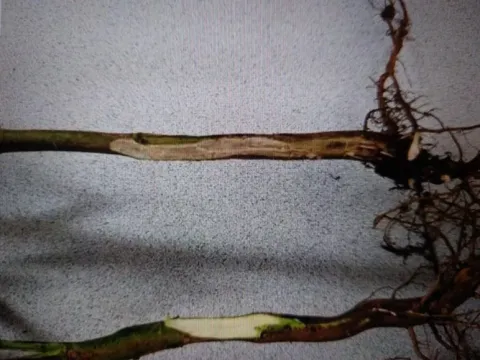
Examination of the roots often reveals a distinct browning and disintegration of the cortex. The lateral roots may be severely damaged or rotted, and in moist conditions, a faint bluish mycelial growth may be observed on the surface of the taproot.
Affected plants often show stunted growth and poor pod development. If severe, the pods may drop prematurely, or the seeds within may be small, shriveled, and of poor quality, leading to significant yield reduction.
Field monitoring is most effective during the reproductive stages (R2-R6). Visual inspection of the canopy can reveal localized areas of infection where the characteristic leaf symptoms are most prominent.
##conditions##Development of Fusarium virguliforme is strongly favored by cool and wet soil conditions during the early growing season. Excessive moisture during planting significantly increases the likelihood of infection and rapid spread of the pathogen.
Soil compaction is a major contributing factor. Compaction limits oxygen availability to the roots and disrupts water infiltration, creating an environment that stresses the soybean plants and makes them highly susceptible to fungal penetration.
Temperature fluctuations also influence the disease, with moderate soil temperatures promoting aggressive fungal growth. Following the initial infection, warm and dry periods during the grain-filling stage can exacerbate the symptoms, leading to "sudden" plant death.
Agricultural practices that promote long-term soil moisture retention, such as certain forms of tillage, may inadvertently create favorable conditions for the pathogen. Managing drainage and soil structure is critical for mitigation.
The movement of soil via farm machinery is a primary factor in the long-distance spread of the fungus. Infested soil particles can easily contaminate "clean" fields, necessitating strict sanitation protocols.
##harm##The economic impact of Sudden Death Syndrome is substantial, with yield losses often reaching 50% in heavily infested fields. The reduction in yield is driven by stunted development, flower/pod abortion, and poor seed filling.
Plants affected by SDS exhibit limited root systems, making them exceptionally vulnerable to moisture stress. Even minor droughts that wouldn't affect healthy plants can cause catastrophic death in fields infested with Fusarium virguliforme.
Seed quality is severely compromised, rendering the harvest unsuitable for replanting. Furthermore, the presence of the pathogen in the soil restricts the utility of the land for future soybean cultivation cycles.
The metabolic cost to the plant to manage the fungal toxins results in redirected energy away from yield accumulation. This leads to a decrease in both protein and oil content in the soybean seeds.
The overall risk of the disease necessitates increased financial inputs for specialized seed treatments and potential management changes, which only partially mitigate the damage caused by the pathogen.
##control##The most reliable control strategy is the use of resistant soybean varieties. Breeders have made significant progress in developing lines that can limit fungal colonization and reduce the severity of foliar symptoms.
Crop rotation serves as a useful management tool, although the longevity of the fungus in the soil requires long intervals between susceptible crops. Rotating with non-host crops helps to suppress the build-up of the pathogen population.
Improving soil drainage and reducing compaction are essential agronomic steps. Implementing subsoiling or other deep-tillage practices can enhance root environment and mitigate the triggers that allow the disease to flourish.
Effective seed treatments containing systemic fungicides are widely recommended to protect seedlings from early-season colonization. These treatments can provide a "window of protection" that allows for stronger root development.
- Select varieties with proven field tolerance to Fusarium virguliforme.
- Avoid early planting in cool, waterlogged soils to minimize exposure.
- Sanitize all field equipment before moving between different locations.
- Ensure balanced nutrient management to support overall crop health.