
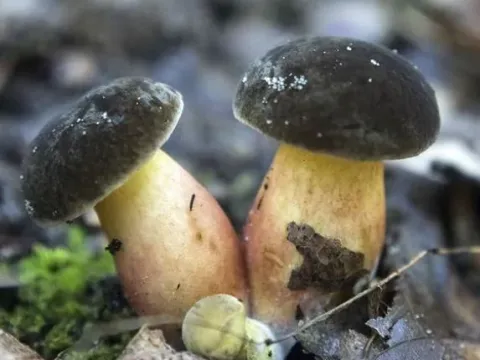
Xerocomus cisalpinus
Xerocomus cisalpinus
It is important to clarify that Xerocomus cisalpinus is not a plant disease or a pathogen. It is a biological species of fungus from the Boletaceae family, belonging to the group of boletes.
What the section contains
Xerocomus cisalpinus
Mycological classification defines this organism as a saprotroph and mycorrhizal fungus. It does not infect the tissues of agricultural crops, trees, or shrubs.
This fungus is not a disease agent, as it lacks parasitic activity. In agronomy, it should be regarded as a component of the forest ecosystem rather than a threat to the harvest.
Biologically, the species is characterized by the presence of mycorrhiza with deciduous trees, most often oaks, which makes it a symbiont rather than an aggressor.
Unlike true phytopathogens, Xerocomus cisalpinus does not reproduce within the vascular system of plants and does not secrete toxins that inhibit crop growth.
The appearance of the mushroom includes a convex cap, with colors ranging from grayish-brown to olive. The surface often cracks with age.
A distinctive feature is the blue staining of the flesh when mechanically damaged or cut, which often confuses people during diagnosis, resembling spotting.
The stem is usually yellowish or reddish, dense, sometimes slightly expanded at the base, and lacks a pronounced reticulated pattern.
The tubular layer under the cap is bright yellow, turning olive-yellow with age. When pressed, the hymenophore also quickly turns blue.
- Cap diameter: 4–10 cm.
- Spore print color: olive-brown.
- Texture: dry, matte, velvety.
The species prefers deciduous forests, often occurring in symbiosis with oaks. It chooses well-warmed areas with moderate soil moisture.
Active fruiting occurs during the summer-autumn period, from July to October. Stable temperatures are required for mycelial development.
The fungus prefers acidic or neutral soils rich in organic matter. It does not tolerate prolonged waterlogging or swampy conditions.
Spore dispersal occurs via air currents. Spores are carried by the wind over long distances, colonizing suitable forest areas.
Unlike plant diseases, this species does not need a weakened host plant to begin its life cycle, developing within the forest litter.
For agroecosystems, this object poses no danger. It does not compete with crops for nutrients or light.
Conversely, the presence of such fungi in shelterbelts indicates a healthy state of the forest ecosystem and normal mycorrhizal exchange.
There is no economic damage associated with this species. Moreover, it is an edible mushroom, making it a valuable biological resource.
Avoiding chemical control against this species is mandatory, as fungicide application in forest zones may negatively affect mycorrhizal fungi.
Thus, attempts to classify Xerocomus cisalpinus as a pathogen are a serious error in agronomic and mycological diagnostics.
Protection measures against this species are not required, as it does not cause crop damage and is not a pest in the classic agricultural sense.
Any actions to eradicate this fungus in the forest zone are pointless and may lead to a disruption of the balance of mycorrhizal fungi in the soil.
Prophylaxis for fungal appearance is not practiced, as their presence is a natural process in forest plantations that maintains soil fertility.
If the fungus is found on land adjacent to agricultural fields, it is recommended to leave it alone as part of natural biodiversity.
If identification of objects in a field is needed, specialists in mycology should be consulted to distinguish beneficial microflora from true disease agents.