
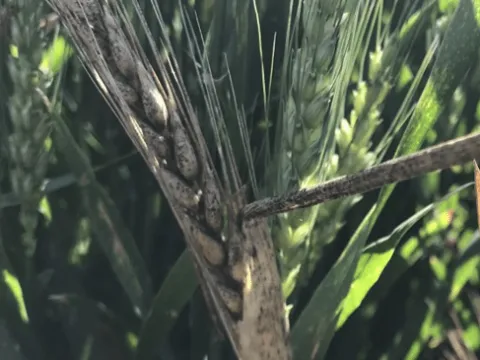
Wheat leaf rust
Winter wheat
The causal agent of this disease is the specialized fungus Puccinia triticina. It is an obligate parasite that undergoes a complex life cycle, often involving an alternate host, although in many regions it propagates mainly through asexual urediniospores.
What the section contains
Wheat leaf rust
The disease type is rust of cereal crops. The fungus primarily affects leaves and leaf sheaths, less frequently stems and glumes of wheat. The infection persists as mycelium on volunteer wheat and winter crops throughout the winter season.
The pathogen demonstrates high adaptability and the ability to form new physiological races, which complicates the breeding of resistant wheat varieties. Spore dispersal occurs via wind currents over long distances.
The life cycle of the pathogen is closely tied to wheat phenology. Primary infection of fields occurs in spring or autumn from sources of inoculum located within a range of several kilometers.
Optimal conditions for fungal viability include high humidity and moderate temperatures. In harsh winters, a significant portion of urediniomycelium may die, but the high reproduction rate compensates for losses as soon as temperatures rise.
The first signs of the disease appear on the leaf surface as small, randomly scattered rust-brown pustules (uredinia). They are circular or oval in shape and break through the leaf epidermis as they mature.
As the pathogen develops, the pustules merge, causing premature yellowing and drying of the leaf blade. The leaf loses its photosynthetic activity, which is critical during the grain-filling period.
At the end of the vegetation period, black telia pustules may form on the undersides of leaves and sheaths; this is the teliospore stage designed for overwintering or survival under adverse conditions.
Visually, an infected field may look "scorched" or show a brownish dust. The presence of infection is easily verified by wiping a white piece of paper across an infected leaf, which will leave a characteristic rusty spore stain.
A distinctive feature is the lack of clear zonal distribution, common in other rust types; the pustules are distributed evenly across the entire leaf surface.
The primary factor in the development of leaf rust epiphytotics is the presence of free moisture (dew, fog, rainfall) on leaf surfaces for several consecutive hours.
The optimal temperature for spore germination and pustule formation ranges from +15°C to +25°C. Under these conditions, the fungal life cycle takes only 7 to 10 days.
High relative humidity (above 70%) significantly accelerates the spread of infection throughout the field. Dense crop stands create a favorable microclimate with reduced moisture evaporation.
Excessive nitrogen fertilization, which triggers vigorous vegetative growth, facilitates easier penetration of fungal hyphae into plant tissues.
A warm and wet autumn favors early infection of winter wheat seedlings, creating a strong inoculum reservoir for the fungus to overwinter and initiate rapid development in the spring.
Wheat leaf rust is considered one of the most destructive wheat diseases. Yield losses in cases of severe infestation can range from 15% to 40% or more, depending on the variety and the timing of the outbreak.
The disease disrupts the plant's water balance by increasing transpiration, leading to stunted growth. As a result of the infestation, the weight of 1000 grains and the test weight are significantly reduced.
Infection of the flag leaf, which provides up to 70% of the nutrients for the grain head, is the most critical. If the infection reaches it before the flowering stage, grain quality drops sharply (reduced protein and gluten content).
Decreased photosynthesis leads to the depletion of nutrient reserves, negatively affecting the winter hardiness of the crop. Plants become weakened and more susceptible to secondary infections.
Economic losses arise not only from reduced yield but also from the high costs of protective measures, without which commercial wheat production would become unprofitable.
The primary control method is the cultivation of resistant and tolerant wheat varieties. Breeding for resistance remains the most effective and environmentally friendly strategy.
An important agronomic practice is the destruction of volunteer wheat plants, which act as a "green bridge" for the transmission of infection from one season to the next.
Adhering to optimal sowing dates helps avoid peak periods of spore dispersal. Avoiding excessive nitrogen fertilization in favor of balanced phosphorus and potassium application enhances plant immunity.
- Application of systemic fungicides (triazoles, strobilurins) upon the appearance of the first disease signs.
- Monitoring of crop fields during critical development stages (stem elongation to heading).
- Use of fungicide-treated seeds to protect young seedlings.
Repeat fungicide applications are performed if the infection pressure remains high, although economic feasibility must be evaluated by an agronomist based on weather forecasts and the severity of the disease development.