
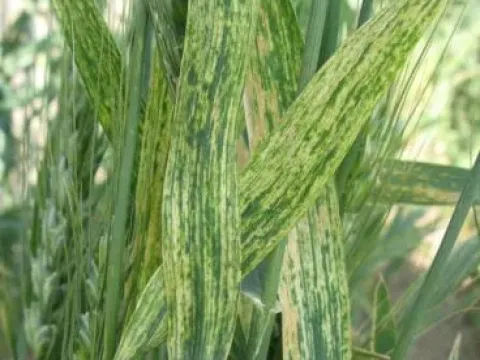
Wheat streak mosaic
Eastern wheat
The causative agent of the disease is the Wheat streak mosaic virus (WSMV). It is a single-stranded RNA virus classified within the Tritimovirus genus of the Potyviridae family.
What the section contains
Wheat streak mosaic
This virus has a broad host range, primarily infecting winter wheat and winter barley, as well as various wild grass species that serve as alternate hosts.
The primary vector responsible for transmission is the wheat curl mite (Aceria tosichella). These microscopic mites acquire the virus while feeding on infected plant tissue.
The virus persists in the environment during the summer months within volunteer wheat and perennial grasses. These act as "green bridges" that harbor the virus until new crops emerge.
Once the mites colonize young seedlings, they transmit the viral particles, initiating systemic infection within the developing cereal plants.
Symptoms typically manifest as yellow or light green streaks that run parallel to the leaf veins. These streaks are often discontinuous and may appear as mosaic patterns.
As the infection progresses, affected plants exhibit stunted growth and reduced vigor. The foliage may become increasingly chlorotic, significantly inhibiting photosynthesis.
Plants infected early in the season often show severe stunting and abnormal tillering. The leaves may curl or twist, leading to an overall discolored, mottled appearance.
In the reproductive stage, infected plants often fail to produce fully developed heads. Spikes can remain sterile, resulting in a complete lack of grain formation in severe cases.
If grain does develop, it is typically shriveled, lightweight, and of poor quality, which drastically reduces the overall yield and market value of the crop.
The development of wheat streak mosaic is heavily favored by warm, dry autumns that extend the activity period of the wheat curl mite population.
The presence of a "green bridge"—volunteer wheat or grassy weeds—in or near fields serves as the primary reservoir for both the mites and the virus.
Wind is the critical factor for the dispersal of the mites. It carries them from infested volunteer wheat or mature crops onto emerging winter wheat seedlings.
Mild winter temperatures allow both the vector and the virus to survive on established winter crops, maintaining the infection cycle until the following spring.
Early planting of winter cereals increases the risk of infection, as it provides a longer period for mite colonization and viral transmission before the onset of cold weather.
The primary impact of the disease is the significant reduction in photosynthetic efficiency, which directly leads to substantial yield losses in wheat and barley.
Infected fields may experience yield reductions ranging from 10% to over 50% depending on the timing of the infection and the environmental conditions during the season.
Beyond yield reduction, the quality of the harvested grain is compromised. The presence of shriveled, low-test-weight grain reduces the overall value of the produce.
Infected plants exhibit reduced tolerance to cold and drought stress, which can lead to increased winterkill or further decline during the spring growing season.
The cumulative effect of widespread infection can undermine the economic viability of cereal production in regions where the virus and its vector are well-established.
The most effective strategy for managing wheat streak mosaic is the complete elimination of volunteer wheat and weeds at least two weeks before planting new crops.
Maintaining a period of host-free time prevents the bridge of infection and significantly lowers the initial mite pressure on emerging seedlings.
The use of resistant or tolerant wheat varieties is the most reliable method to protect crop yields against the damage caused by the WSMV infection.
Adjusting planting dates to avoid the peak periods of mite migration can help minimize the risk of early colonization and subsequent systemic disease spread.
Spatial isolation between new plantings and fields infested with the previous year's volunteer growth is critical to preventing the movement of the vector into the new crop.