
Wheat tan spot
Pyrenophora trichostoma
Description
Symptoms
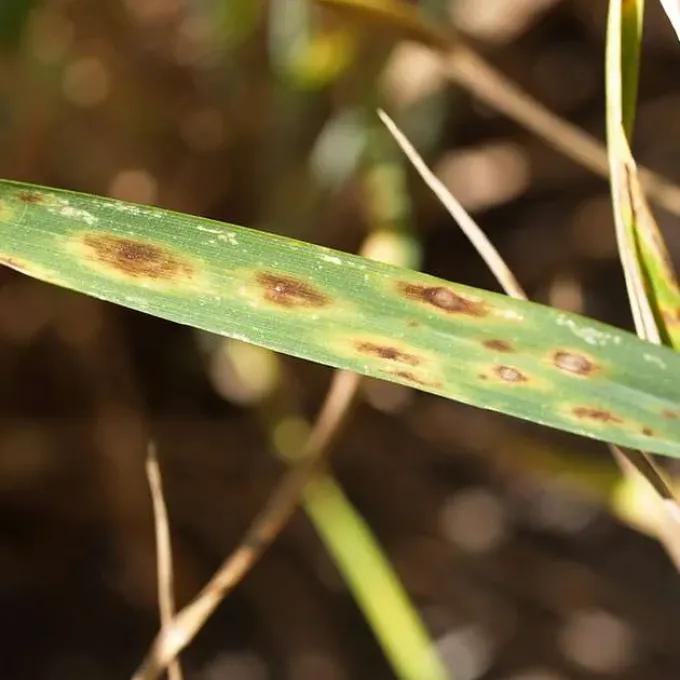
The disease starts as small, tan-colored flecks on the lower leaves, typically surrounded by a distinct yellow chlorotic halo.
As the infection advances, these lesions expand into characteristic lens-shaped or irregular brown necrotic blotches.
Under persistent wet conditions, individual lesions merge, eventually causing the entire leaf tissue to turn yellow and brown before drying up.
A dark, velvety appearance may be observed on the lesions in humid environments, representing the mass production of conidia.
While primarily a foliar disease, severe infections can extend to the leaf sheaths, stems, and glumes of the wheat spike.
Pathogen
The causative agent of tan spot is the ascomycete fungus Pyrenophora tritici-repentis (anamorph Drechslera tritici-repentis).
It is a necrotrophic pathogen, meaning it kills host tissue to extract nutrients, often by producing specific host-selective toxins.
The fungus survives the off-season primarily as saprophytic mycelium and pseudothecia within wheat stubble left on the soil surface.
Primary inoculum consists of ascospores released from residues during moist, cool spring weather, which are dispersed by wind to emerging wheat leaves.
Secondary spread occurs through conidia produced on lesions, facilitating rapid disease progression during the growing season under favorable conditions.
Conditions for development
Tan spot development is heavily dependent on moisture; long periods of leaf wetness are required for spore germination and tissue penetration.
Temperatures ranging from 18°C to 28°C are considered optimal for the rapid infection and reproduction of the pathogen.
Conservation tillage practices, such as no-till, increase disease risk by leaving large quantities of infected crop residue on the surface.
Frequent rainfall or high humidity events facilitate the upward movement of inoculum from the lower canopy to the upper flag leaves.
Dense wheat stands with high canopy humidity are more prone to rapid disease outbreaks compared to well-ventilated fields.
Why it matters
The primary impact of tan spot is the destruction of photosynthetic leaf area, which severely limits grain filling and overall plant vigor.
Significant yield losses occur, ranging from 10% to over 40%, depending on the timing of the infection and the cultivar's susceptibility.
Infected crops often produce shriveled or lightweight grains, leading to reduced test weight and lower overall market grade.
Plants weakened by tan spot are more susceptible to secondary stressors, including late-season drought or root rot complexes.
If the infection reaches the glumes, it can reduce seed quality, which is particularly problematic for saved seed production.
Protection
Crop rotation is the most effective cultural practice, as it breaks the life cycle of the fungus by allowing crop residues to decompose.
Deep burial of crop residues via tillage can reduce the primary inoculum load by accelerating the breakdown of infected wheat stubble.
Fungicide applications, particularly those containing strobilurins and triazoles, are effective when applied at the appropriate growth stage.
Planting resistant or moderately resistant wheat varieties remains the most sustainable approach to managing the disease in high-risk areas.
Integrated weed management is crucial, as the fungus can persist on various wild grass hosts that serve as bridges for infection.
Discussion
No discussions yet — be the first.