
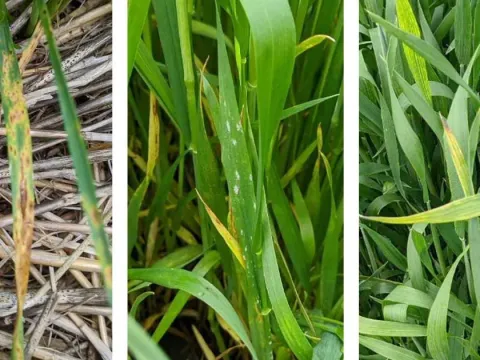
Wheat tan spot
Wheat yellow
Tan spot is a foliar disease of wheat caused by the fungal pathogen Pyrenophora tritici-repentis (anamorph Drechslera tritici-repentis).
What the section contains
Wheat tan spot
The fungus survives between crops on infected wheat stubble and other crop residues, making it a persistent threat in continuous wheat cropping systems.
The pathogen produces both asexual conidia for rapid secondary cycles and sexual ascospores, which are often the primary source of initial spring infection.
It predominantly infects wheat (winter and spring) and winter barley, colonizing leaf tissues and releasing host-specific toxins that cause the characteristic lesions.
The fungus is highly adapted to temperate climates where residues remain on the soil surface, providing a continuous substrate for its survival and growth.
Initial symptoms appear as small, tan-colored lesions that are surrounded by a distinct yellow chlorotic halo, a hallmark feature of the disease.
As the infection progresses, these small lesions expand into larger, irregular dark-brown blotches, often causing leaves to yellow and wither prematurely.
Severe infections lead to significant necrosis of the leaf blades, which can result in the entire leaf drying up if environmental conditions remain favorable for the fungus.
In humid conditions, dark brown to black fungal growth may be visible within the centers of the mature lesions, particularly in the lower canopy.
The disease usually moves upward from the lower leaves to the upper leaves, including the flag leaf, during the grain-filling stage of the plant.
The development of tan spot is heavily dependent on moisture. Prolonged periods of leaf wetness and high humidity are essential for spore germination and colonization.
Temperatures between 15°C and 25°C are considered optimal for the pathogen's growth, allowing for rapid disease development during the wheat's vegetative stages.
Conservation tillage practices, such as no-till, favor the disease by keeping infected residue on the soil surface, providing easy access for sporulation.
High nitrogen availability and dense crop canopies can further exacerbate the humidity levels within the crop, creating an ideal microclimate for fungal spread.
- Extended periods of rain or heavy dew.
- Continuous wheat cropping.
- Minimal tillage systems.
The primary damage caused by tan spot is the reduction of the green leaf area, which significantly impacts the plant's photosynthetic capacity.
Reduced photosynthesis during the critical grain-filling period directly translates into lower yields and smaller, shriveled grain kernels.
Severe infestations can lead to substantial yield losses, sometimes exceeding 30-40% if conditions are favorable for the disease and no intervention occurs.
The disease also negatively affects grain quality, which can lead to reduced test weights and compromised processing characteristics for milling and baking.
Plants weakened by the disease are more susceptible to secondary stressors, including other opportunistic pathogens and drought conditions.
Integrated management is essential, focusing on reducing the initial inoculum by promoting the decomposition of infected stubble through deep tillage or burial.
Crop rotation remains one of the most effective strategies to break the disease cycle and reduce the build-up of the pathogen in the soil.
Fungicide applications, particularly those involving strobilurin or triazole chemistry, are critical during the flag leaf emergence to protect the upper canopy.
Choosing resistant or moderately resistant wheat varieties significantly reduces the severity of the disease and the overall reliance on chemical controls.
Regular field scouting starting at the beginning of the stem elongation phase is crucial to determine the timing and necessity of chemical interventions.