
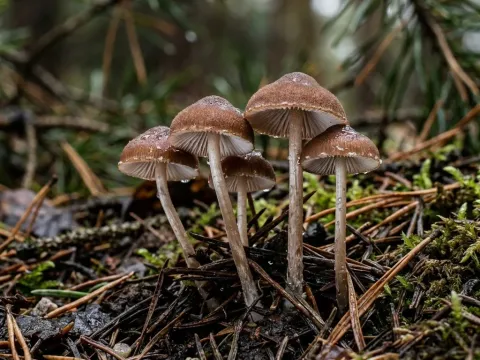
Strobilurus stephanocystis
Strobilurus stephanocystis
Strobilurus stephanocystis is a species of mushroom in the family Physalacriaceae. It is critical to clarify that this organism is not a disease of agricultural or forest crops, but rather a xylotrophic saprotroph.
What the section contains
Strobilurus stephanocystis
This fungus specializes in the decomposition of dead organic matter, specifically fallen pine cones. It does not infect or harm living plant tissues, therefore classifying it as a plant pathogen is biologically incorrect.
The fungus produces small fruiting bodies (caps) measuring 2-4 cm in diameter, typically featuring brownish or ochre hues. The hymenium consists of frequent, pale-colored gills.
The mycelium of the fungus actively colonizes the scales of fallen pine cones, secreting specific enzymes to break down lignin and cellulose. This is a classic example of a decomposer within forest ecosystems.
Unlike dangerous plant pathogens, Strobilurus stephanocystis provides beneficial sanitary functions by accelerating the mineralization of organic matter in forest soils.
The primary sign of the fungus's presence is the emergence of fruiting bodies directly from old, overwintered pine cones partially buried in the forest litter.
Fruiting occurs mainly during the spring, often shortly after the snow melts. During this period, mass appearance of small brownish caps on thin stalks can be observed.
The stalk of the fungus is often deeply embedded in the substrate, as it connects to the buried pine cone via a long, tough root structure (pseudorhiza).
Microscopic examination reveals characteristic stephanocysts — specialized cells crowned with crystals, which provided the basis for the specific epithet of this species.
There are no signs of necrosis on living plant tissues surrounding the cones, confirming that the fungus does not possess parasitic traits.
Active mycelial development requires high humidity levels in both air and soil, typical for coniferous forests in spring. The optimal temperature for fruiting body formation ranges from +5 to +15 degrees Celsius.
The primary substrate for this species is the cone of the Scots pine (Pinus sylvestris). It rarely occurs on spruce cones, where its ecological niche is occupied by other members of the Strobilurus genus.
A thick layer of forest floor litter helps maintain the microclimate necessary for the mycelium's activity throughout the pine cone decomposition cycle.
Spore dispersal occurs via wind and insect vectors, allowing the fungus to quickly colonize available substrates across large forest areas.
In cases of dry spring weather, the formation of fruiting bodies is significantly inhibited, although the internal mycelium remains viable until favorable conditions return.
From an agronomic and silvicultural perspective, this fungus poses no threat. It is not an agent of disease for trees, shrubs, or agricultural crops.
The lack of pathogenic impact on living flora makes it a completely safe component of forest ecosystems. Conversely, its activity contributes to the clearance of organic debris.
The presence of Strobilurus stephanocystis signifies a healthy nutrient cycling process, where organic waste is converted into available mineral nutrients for plant growth.
It is not considered a pest and does not require monitoring or control measures in any professional management context.
This species is a natural component of the local biocenosis, fulfilling an essential ecological role without needing intervention.
Since the fungus is not a pathogen or a pest, no protection or control measures have been developed or are required.
Any attempt to use chemical control against this fungus would be counterproductive and harmful to the natural microflora of the forest ecosystem.
In forest management or tree nurseries, removing fallen pine cones is unnecessary, as their recycling by saprotrophs is a natural process for soil fertility restoration.
Prophylaxis is not applicable to this species, as it does not negatively impact crop yields or tree health.
The agronomic approach is to distinguish between beneficial saprotrophs and harmful pathogens to avoid unnecessary expenditure on suppressing harmless forest inhabitants.