
Tirmania
Tirmania
The genus Tirmania consists of hypogeous fungi that are commonly known as desert truffles, found primarily in arid and semi-arid regions.
What the section contains
Tirmania
It is important to clarify that Tirmania is not a plant disease or a parasite; it is a beneficial mycorrhizal fungus.
These fungi form symbiotic relationships with the root systems of specific desert plants, providing them with essential nutrients and water.
Biologically, these organisms belong to the family Pezizaceae and have evolved to survive in extreme heat and low-moisture environments.
In the context of botany and agronomy, they are classified as beneficial soil biota rather than harmful phytopathogens.
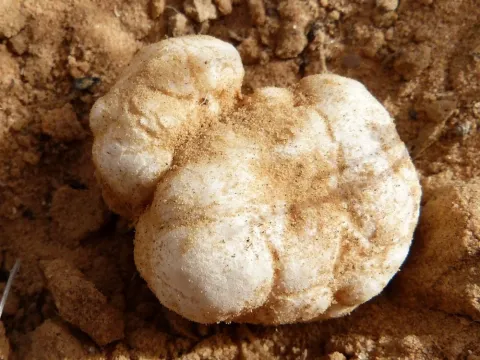
The most visible sign of Tirmania activity is the subtle cracking or mounding of the soil surface caused by the developing fruiting bodies below.
The fruiting bodies themselves are subterranean, pale-colored tubers that lack a distinct stalk or root system.
When sliced, the interior reveals a marble-like pattern with distinct veins, which is a characteristic feature of the Tirmania species.
The host plants associated with these fungi typically show robust growth and enhanced resistance to drought conditions.
A mild, earthy aroma is often emitted from the soil near the fruiting bodies, particularly after significant rainfall events.
Tirmania development is strictly dependent on a specific climate, requiring sandy, alkaline soils with low organic matter content.
High soil temperatures are essential for the maturation process, making desert environments the primary habitat for these fungi.
Rainfall is the most critical factor, acting as a trigger for the mycelium to initiate the production of fruiting bodies.
The presence of specific host plant species is mandatory for the establishment of the symbiotic connection and survival of the fungus.
Well-aerated soil structures are necessary for the gas exchange required by the developing subterranean truffle.
Tirmania does not cause any harm to crops, as it does not possess the mechanisms to infect or damage plant tissue.
It provides significant environmental benefits by improving soil structure and nutrient uptake for desert flora.
There is no negative economic impact associated with this fungus; in fact, it is a highly valued commercial product in many regions.
The only damage associated with these fungi is the ecological disruption of the soil crust caused by over-harvesting activities.
As a non-pathogenic organism, it presents no risk to agricultural stability or food security.
Control measures are entirely unnecessary for Tirmania, as it is a beneficial component of the desert ecosystem.
No fungicides or chemical treatments should be applied, as these would harm the beneficial soil microbiology and the host plants.
Management efforts should focus on sustainable harvesting practices to ensure the long-term viability of the fungus population.
Conservation of natural habitats is the only recommended strategy to maintain the presence of these symbiotic organisms.
Proactive prevention is not applicable since there is no negative disease pressure to mitigate or manage.