
Tirmania africana
Tirmania africana
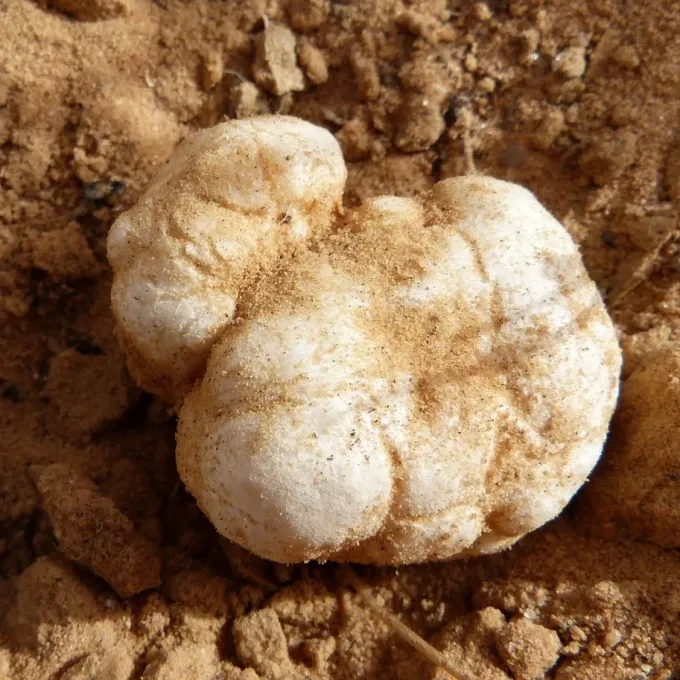
Description
Symptoms
Early identification of the fungus is challenging because all vegetative and reproductive stages occur underground. The primary sign is a visible reduction in the vegetative vigor of the host plant, often manifesting as stunted growth or chlorotic leaves.
A closer inspection of the root zone will reveal distinct, tuber-like fruiting bodies. These structures vary in size and color, usually appearing as pale, rounded formations embedded in the soil near the plant's primary root system.
Infected plants frequently show signs of water stress, even when soil moisture levels are adequate, because the fungal mycelium interferes with the root's ability to uptake water and dissolved minerals efficiently.
- Significant reduction in plant height and biomass.
- Pale yellowing (chlorosis) of the foliage.
- Presence of firm, tuberous fungal bodies near roots.
- Delayed development cycles, particularly during flowering and fruit setting.
Microscopic analysis reveals a dense network of hyphae entwined around root hairs. This physical barrier complicates the uptake of essential nutrients, leading to poor physiological performance of the crop throughout its growing season.
Pathogen
Tirmania africana is a species of hypogeous fungus belonging to the Pezizaceae family, commonly recognized as a desert truffle. In an agricultural context, it acts as an obligate symbiont, forming an ectomycorrhizal association with the root systems of various host plants.
Biologically, the fungus functions as a nutrient sink, diverting carbohydrates produced by the host plant to support the development of its substantial underground fruiting bodies. It is a eukaryotic organism that remains dormant in the soil for extended periods until environmental cues trigger its life cycle.
The fungus disperses through spores that are highly resistant to the extreme heat and desiccation characteristic of arid environments. Once germinated, the mycelium colonizes the rhizospheric zone, weaving itself into the plant's root structures to facilitate nutrient exchange.
Unlike necrotrophic pathogens that kill plant tissues through enzymatic degradation, Tirmania africana exerts its influence through competitive resource exploitation. It effectively acts as a physiological drain, altering the metabolic balance of the host plant.
The biological success of this fungus is linked to its ability to survive in nutrient-poor, sandy soils. While it provides some minerals to the plant in exchange for carbon, the net impact on commercial crops is often negative due to the high energy demand of the large fruiting bodies.
Conditions for development
Tirmania africana is strictly adapted to arid and semi-arid climatic zones. It thrives in well-aerated, sandy soil profiles with low organic matter content, which are common in the North African and Middle Eastern regions.
Moisture is the primary driver for its development. Seasonal rain events act as a trigger, prompting the transition from dormant spores to active mycelial growth and subsequent formation of reproductive fruiting bodies.
The fungus requires stable soil temperatures to flourish, typically within the range of 20 to 30 degrees Celsius. Extreme cold or prolonged waterlogging suppresses its activity, making these conditions unfavorable for the fungus.
Agricultural practices, such as excessive irrigation or intensive fertilization, significantly impact the survival of the fungus. High nitrogen levels, in particular, often discourage the formation of mycorrhizal associations.
Geographical distribution is restricted to regions where the specific host plant species and climatic conditions coexist. However, the longevity of its spores ensures that it can persist in the soil for years, waiting for the right conditions to reactivate.
Why it matters
The main harm inflicted by this fungus is the competitive diversion of photoassimilates. By siphoning sugars intended for crop yield, the fungus significantly reduces the productivity and economic output of the agricultural land.
Economic losses are compounded by lower crop quality, including smaller grain sizes and reduced nutritional density in produce. In cereal fields, this leads to a notable decrease in the thousand-kernel weight and overall marketability.
Persistent colonization weakens the host's physiological resilience, making the plants more susceptible to secondary infections from bacterial pathogens or other common soil-borne fungal diseases that enter through stressed tissues.
In industrial agriculture, high infestation rates can cause uneven crop emergence and significant losses in plant populations. This often necessitates costly replanting and extensive soil remediation efforts to restore productivity.
While the fruiting bodies of Tirmania africana are highly prized as a culinary delicacy, their presence in fields intended for traditional crop production is viewed as a significant nuisance, as the market value of the truffles rarely offsets the loss in agricultural yields.
Protection
Management centers on crop rotation strategies that break the cycle of infection. By alternating susceptible crops with non-host species, growers can effectively reduce the spore load within the soil profile.
Deep tillage is a highly effective mechanical control measure. By physically disrupting the underground mycelial networks and destroying developing fruiting bodies, farmers can significantly limit the fungus's ability to reproduce.
The use of systemic fungicides is theoretically possible but requires careful application to ensure the chemical reaches the root zone. Targeted applications during the early stages of plant development are generally the most effective.
Preventive measures focus on site selection and soil management. Maintaining optimal moisture levels in irrigated systems and avoiding excessive organic amendments can help manage the ecological niche favorable to the fungus.
Biological control methods involving the application of antagonistic bacteria, such as Bacillus subtilis, have shown promising results. These bio-agents compete with the fungal mycelium in the rhizospheric zone, suppressing its growth without negatively impacting the crop.
Discussion
No discussions yet — be the first.