
Tobacco frogeye leaf spot
Cercospora nicotianae
Description
Symptoms
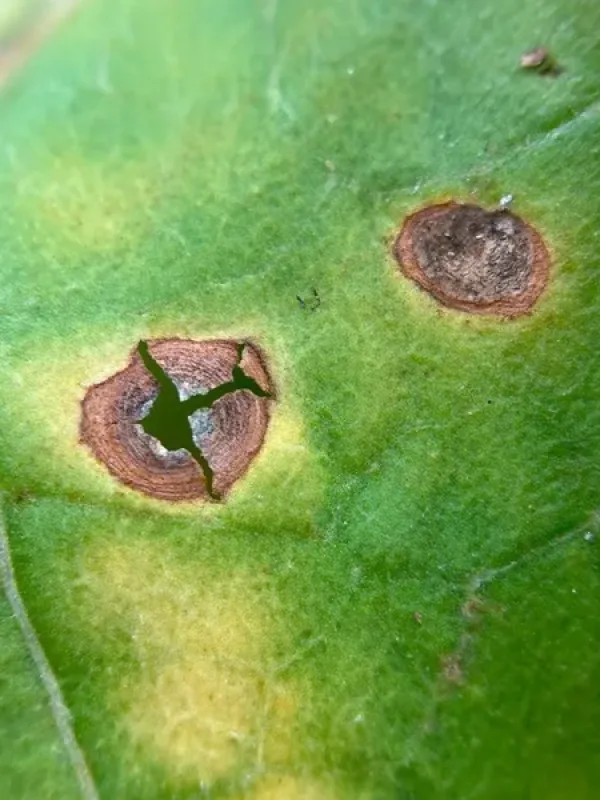
The first symptoms of the disease appear on the lower, older leaves as small, circular spots that eventually increase in size.
A distinctive feature of these spots is their tan or greyish-white centers, surrounded by a dark brown or black margin.
Under conditions of high humidity, a greyish-brown fuzzy mold forms in the center of the lesions, representing the conidiophores of the fungus.
As the disease progresses, these spots often coalesce, causing large areas of the leaf tissue to necrotic, yellow, and die.
Severely affected leaves become brittle, dry out, and drop prematurely, leading to significant yield and quality losses.
Pathogen
The disease is caused by the fungus Cercospora nicotianae, which thrives as a parasite on tobacco leaves during the growing season.
The pathogen survives between seasons in the soil on crop debris and can also be disseminated through infected tobacco seeds.
Conidia of the fungus are spread by wind, rain splashes, and during cultivation practices, infecting healthy plant tissue upon contact.
Once inside the leaf, the fungus colonizes the host tissues, absorbing nutrients and inducing the characteristic spotting symptoms.
The biology of the pathogen is highly dependent on environmental conditions, allowing it to complete multiple cycles during a single growing season.
Conditions for development
The development of frogeye leaf spot is heavily favored by prolonged periods of high humidity, typically exceeding 85%.
Warm temperatures, with an optimum range between +20°C and +28°C, are highly conducive to the rapid germination of fungal spores.
Crowded plantings that prevent adequate air circulation create a localized microclimate that significantly accelerates the spread of the infection.
Excessive nitrogen fertilization can result in more susceptible, tender leaf tissues that are easily penetrated by the fungus.
Frequent rainfall or persistent morning dews leave films of moisture on the leaves, which are essential for successful spore infection.
Why it matters
The primary economic impact of frogeye leaf spot is the degradation of the quality of the harvested tobacco leaf.
Infected leaves have reduced chemical profiles, showing lower levels of nicotine and sugars, which impairs the smoking quality.
Massive necrosis of leaf tissue leads to direct yield losses, as leaves become unmarketable for industrial processing.
Increased susceptibility to other stresses, such as wilting or drought, occurs in heavily infected plants, further suppressing growth.
The presence of the pathogen in the field necessitates higher management costs for site cleanup and chemical control applications.
Protection
Implementing a long-term crop rotation strategy is the most effective cultural method to reduce the soil-borne inoculum levels.
Deep plowing after harvest to bury all tobacco stalks and leaf debris is crucial for minimizing the fungus's ability to survive the winter.
Selecting and planting resistant or less susceptible tobacco varieties can significantly reduce the risk and severity of outbreaks.
Ensuring proper plant spacing is essential to improve airflow within the crop canopy, reducing the moisture retention on leaves.
- Application of appropriate fungicides during the early stages of disease development to protect the crop.
- Effective weed management to remove potential host plants that may harbor the fungus.
- Careful moisture monitoring in storage facilities to prevent secondary contamination during the curing process.
Discussion
No discussions yet — be the first.