
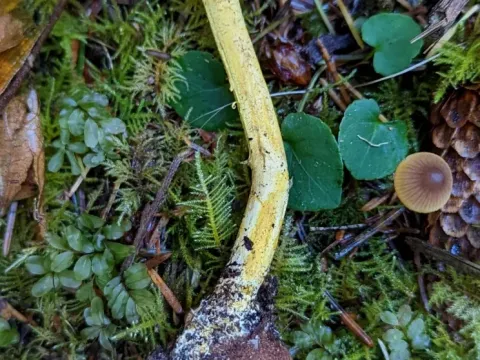
Tolypocladium capitatum
Tolypocladium capitatum
The pathogen is Tolypocladium capitatum, a fungal species belonging to the Ophiocordycipitaceae family. Historically, it was classified under the genus Cordyceps.
What the section contains
Tolypocladium capitatum
It is a specialized mycoparasite that exclusively infects the underground fruiting bodies of certain fungi, primarily those belonging to the Elaphomyces genus.
The fungus develops by infiltrating the host's tissue with its mycelium, gradually consuming the nutrient reserves of the host mushroom over time.
Its life cycle culminates in the production of distinct aerial stroma, which erupt from the soil surface to release spores into the environment.
Unlike entomopathogenic fungi, this species focuses its biological potential on other fungi, making it a unique study subject in mycology.
The presence of the fungus is signaled by the emergence of club-shaped fruiting bodies from the forest floor during the autumn months.
The fruiting body consists of a rounded, yellow-brown head (the fertile part) and a long, slender stalk that extends deep into the soil.
When carefully excavated, the base of the stalk is found connected to the subterranean, ball-like host fungus, such as a deer truffle.
The surface of the head is often textured with tiny pimple-like structures, which are the openings of the perithecia where spores are produced.
Host mushrooms often show signs of structural degradation or abnormal development as the parasite consumes their internal matrix.
Development is contingent upon a specific forest habitat characterized by rich soil organic matter and the presence of abundant Elaphomyces hosts.
High soil moisture and mild temperatures are critical for the metabolic processes that allow the fungus to infect and colonize its target host.
Spore dispersal relies on environmental conditions, including wind and adequate air humidity, which facilitate the spread of spores across the forest floor.
The fungus is most active and visible during the wetter periods of the year when both the host and the parasite reach their reproductive phases.
Ecological stability is essential, as the fungus requires a long, undisturbed period to complete the slow process of host colonization and stroma formation.
Tolypocladium capitatum causes no harm to agricultural crops, horticultural plants, or forestry trees as its diet is restricted to forest mushrooms.
There is no economic damage associated with this fungus, and it does not impact food security or agricultural productivity in any capacity.
Within the forest ecosystem, it acts as a natural regulator, influencing the population dynamics of other fungal species residing in the soil.
Its impact is purely ecological and highly localized, causing no disturbances to the overall health or structure of the forest habitat.
Scientists view this fungus as an interesting example of co-evolution between a parasite and its specific host species.
No control measures are necessary for Tolypocladium capitatum as it is not a pest or a pathogen that affects human-managed environments.
Prophylactic strategies are entirely irrelevant, given that this species does not inhabit agricultural land or domestic gardens.
No eradication efforts are required, as the fungus plays its natural role as a member of the forest mycota, contributing to biodiversity.
Agrotechnical interventions are not recommended and would be completely ineffective due to the specialized nature of the fungus.
The best practice is to allow it to fulfill its ecological role within the forest, as it poses no threat to human activities or commercial interests.