
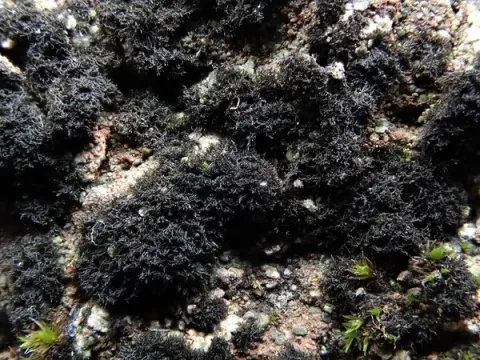
Spilonema revertens
Spilonema revertens
It is crucial to clarify that Spilonema revertens is not a disease-causing agent in plants or crops. It is a specific type of lichen belonging to the Peltulaceae family.
What the section contains
Spilonema revertens
This organism exists in a symbiotic relationship between a fungus and cyanobacteria, which perform photosynthesis to sustain the biological structure.
The lichen is an epiphyte, meaning it lives on the surface of other plants, such as tree bark, without extracting any nutrients or water from the host tissue.
There is no evidence of phytotoxicity or pathogenic interaction between this species and its host plants.
Therefore, classifying it as a plant disease is scientifically incorrect as it does not interfere with plant development or health.
Spilonema revertens thrives in habitats that provide consistent moisture and sufficient light, such as temperate forests and damp environments.
It often colonizes surfaces like old tree bark, rocks, and acidic substrates where conditions are stable enough for slow-growing organisms.
The development of these lichens is highly dependent on humidity levels, often utilizing atmospheric moisture such as fog and dew.
The species is considered an indicator of environmental quality, as it prefers regions with cleaner air and lower levels of industrial pollution.
Growth rates are characteristically slow, requiring years to form noticeable colonies on stable surfaces.
From an agronomic perspective, Spilonema revertens causes no damage to agricultural or ornamental plants.
It does not cause infections, rotting, or necrosis, and it does not affect the yield or quality of tree-based crops.
While some growers might mistake it for a disease, it is purely a cosmetic feature of older trees that have provided a stable base for the lichen to grow.
The presence of this lichen does not weaken the tree structure and has no negative impact on the tree's physiological vitality.
Overall, the agricultural harm is non-existent, and no economic losses are associated with this lichen species.
Since this lichen is not a plant pathogen, there are no established control measures or eradication programs required.
If the appearance of the lichen on tree trunks is considered undesirable, mechanical removal using a soft brush is the only recommended approach.
Chemical treatments, such as fungicides, are generally ineffective and inappropriate for lichen removal because they are designed for active fungal parasites.
Good orchard management, including proper pruning and tree maintenance, is usually sufficient to discourage excessive colonization of epiphyte species.
Maintaining the overall vigor and health of the tree will allow it to thrive, and the lichen will remain a harmless occupant of the outer bark layer.