
Description
Symptoms
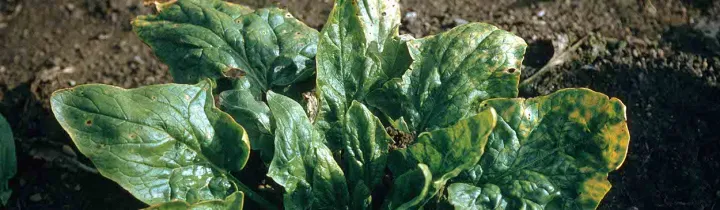
The most characteristic signs of infection are the inward curling of leaves and significant stunted growth. The upper foliage becomes twisted and distorted, often referred to as the curly top syndrome.
Leaves on infected plants tend to become thickened, brittle, and yellowish in appearance. Vein clearing is frequently observed, serving as a primary indicator of early-stage infection.
Root system development is severely hampered, resulting in weak, dwarfed plants. If infected early in the season, plants may fail to produce a marketable rosette of leaves entirely.
Symptoms often appear in a patchy distribution within the field, reflecting the erratic feeding patterns of the leafhopper vector. Infected plants stand out due to their pale color and abnormal shape.
As the disease progresses, the plant loses turgor and may eventually collapse. There is no presence of fungal spores, molds, or lesions, which helps distinguish this viral issue from common fungal pathogens.
Pathogen
Spinach curly top is caused by the Beet curly top virus (BCTV). This virus is a significant pathogen that affects numerous crops, particularly those in the Amaranthaceae family, including garden spinach.
The virus is not transmitted mechanically or through seeds. Instead, it relies on a specific vector for transmission: the beet leafhopper (Circulifer tenellus). The insect acquires the virus while feeding on infected weeds and transmits it to the spinach.
Once injected into the plant tissues, the virus moves through the phloem. This systemic infection rapidly alters the plant's metabolic pathways and growth regulation mechanisms.
BCTV is characterized by its wide host range and significant genetic diversity. These factors make it a persistent problem in vegetable production, as different strains can manifest with varying severity.
The pathogen thrives in warm climates where leafhopper populations are active. Understanding the viral transmission cycle is essential for any successful integrated pest management program.
Conditions for development
The disease development is heavily dependent on the migration patterns and population density of the beet leafhopper. Hot and dry weather conditions are known to trigger mass movements of insects into cultivated fields.
When surrounding wild vegetation dries up due to drought, leafhoppers migrate to irrigated crops like spinach. This makes spinach particularly vulnerable during dry spells in mid-summer or late spring.
The presence of weeds that serve as reservoirs for BCTV is a critical risk factor. These plants maintain the virus throughout the year, ensuring a steady supply for new generations of leafhoppers.
Management of field conditions, including balanced irrigation, is important to reduce plant stress. However, irrigation itself does not stop the virus if the insect population remains uncontrolled.
Seedlings are the most susceptible stage for infection. Protection during the first few weeks after germination is crucial to avoid substantial crop loss across the entire field.
Why it matters
The primary economic harm is the total loss of marketability of the spinach crop. Plants afflicted with curly top are not suitable for fresh market sales or food processing.
In cases of high leafhopper pressure, entire plantings can be destroyed within a few weeks. The inability to cure viral infections means that infected plants are considered a total loss.
Costs associated with crop failure are compounded by the labor and input expenses already invested. For commercial farmers, a curly top outbreak represents a significant financial setback.
Physiological changes, including reduced photosynthesis and altered nutrient content, make even slightly symptomatic leaves unpalatable. The yield potential is severely compromised as the plant's energy is redirected to the infection.
Without proactive control measures, the virus can spread quickly to neighboring plots. This ripple effect makes regional cooperation in weed and insect management vital for sustainable spinach production.
Protection
Effective control centers on managing the beet leafhopper population. Insecticide applications are necessary during the early stages of plant growth to reduce the chances of viral transmission.
Eliminating weed hosts in and around the field is an essential preventative measure. By reducing the number of virus-carrying plants, the risk of transmission to spinach is significantly lowered.
Using floating row covers provides an excellent physical barrier against leafhoppers. This method is highly effective for protecting small-scale spinach crops from insect feeding.
Adjusting planting dates to avoid peak leafhopper migration can also mitigate damage. Proper spatial isolation from known reservoir plants helps keep the disease pressure at a manageable level.
- Monitor leafhopper populations using yellow sticky traps.
- Rotate crops to break the cycle of virus reservoirs in the soil.
- Regularly scout fields for symptomatic plants to prevent further spread.
Pathogens and affected parts
Affects crops · 1
Discussion
No discussions yet — be the first.