
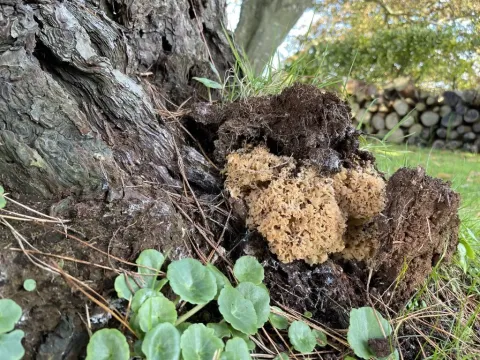
Root rot
Sparassis
The disease is caused by the fungus Sparassis crispa, commonly referred to as the cauliflower fungus. While it is a popular edible mushroom, it acts as a dangerous parasite for various conifer species.
What the section contains
Root rot
The fungus functions as a wood-decay pathogen, infecting the root system and the lower stem, ultimately leading to brown cubical rot in the heartwood.
Infection primarily occurs through basidiospores landing on fresh wounds or via root contact between an infected tree and a healthy one.
The fungus mycelium is capable of persisting in stumps and woody debris for years, forming a permanent reservoir of infection in the forest floor.
As an opportunistic pathogen, Sparassis thrives by breaking down structural components of the tree's root system, effectively killing the tree from the roots upward.
The most visible sign of infection is the emergence of characteristic ruffled, cream-colored fruiting bodies near the base of the infected tree in autumn.
Internally, the roots show signs of extensive brown decay, often associated with a brittle texture and a distinct, somewhat pleasant mushroom aroma.
Trees affected by root rot exhibit symptoms such as chlorosis, yellowing of needles, thinning of the crown, and a noticeable reduction in annual growth.
Due to the degradation of the root system, infected trees lose their anchor in the soil, leading to increased risk of windthrow during severe weather events.
Excessive resin flow (resinosis) may appear at the base of the stem, reflecting the tree's attempts to seal off the spread of the fungal mycelium.
High-density stands are particularly vulnerable, as the close proximity of root systems facilitates the rapid spread of the fungus between trees.
Optimal conditions for fungal development include moist, well-aerated soil and moderate temperatures, which favor the spread of mycelial strands.
The presence of large, decaying stumps provides a crucial source of energy for the fungus, allowing it to maintain its population until it reaches a new host.
Mechanical damage to the roots, caused by forestry machinery or wildlife activity, provides direct entry points for fungal colonization.
Sites with poor drainage or soils prone to waterlogging often exacerbate the stress on trees, making them more susceptible to root infection.
Root rot causes significant timber loss, as the decaying root system renders the wood structurally unsound and economically worthless for lumber.
Infected trees become highly susceptible to secondary attacks by bark beetles, which further hastens the decline of the forest stand.
The disease causes gaps in the forest canopy, leading to altered microclimates and the potential for soil erosion on exposed sites.
The long-term economic impact is severe, as affected areas require expensive clearing and replanting, with high risks for the next generation of trees.
Ecologically, the death of large groups of trees disrupts local habitats and biodiversity, changing the successional dynamics of the ecosystem.
The primary control strategy involves the early detection and removal of infected trees, including the systematic extraction of stumps to eliminate infection sources.
Forest managers should prioritize the creation of mixed-species stands to break the pathways of root contact required for fungal spread.
Operational care is essential during harvesting to avoid damaging the roots and bark of remaining trees, which are highly vulnerable to new infections.
Sanitation measures, such as the removal of deadwood and logging residues, help reduce the substrate available for the fungus to multiply.
In specific cases, biological control using antagonistic fungi can be introduced to the soil to compete with and suppress the growth of Sparassis.