
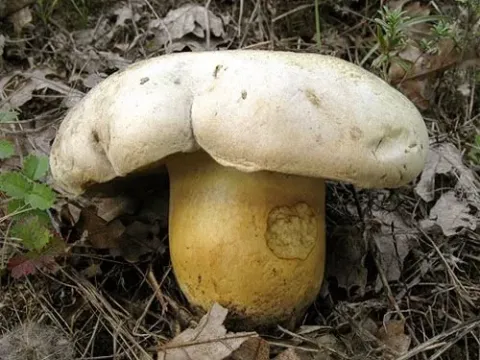
Rooting bolete
Boletus radicans
The rooting bolete (Boletus radicans) is a mycorrhizal fungus belonging to the Boletaceae family and is incorrectly identified as a plant disease.
What the section contains
Rooting bolete
It acts as a beneficial partner to hardwood trees, such as oaks and beeches, rather than as an infectious agent attacking plant tissues.
The fungus does not possess the enzymatic capability to degrade healthy plant matter or cause disease in agricultural crops.
Its biological cycle is strictly associated with forest ecosystems, forming a symbiotic connection that supports tree growth and resilience.
Classifying this organism as a plant pathogen is taxonomically and agronomically incorrect as it lacks parasitic activity towards crops.
The key identification feature is the pale grey or whitish cap and the bright yellow pores that turn blue immediately upon bruising.
The flesh is known for its intense bitter taste, which serves as a biological defense mechanism against certain herbivores and insects.
The stalk, or stipe, often features a swollen or rooting base that penetrates deep into the soil, giving the species its common name.
Fruit bodies appear during late summer and autumn, often near tree roots where the soil moisture is sufficient for fungal development.
Visual identification is usually straightforward due to the distinct color-changing reaction of the pores and the bitter taste.
Optimal growth conditions include well-drained, lime-rich soils with abundant organic matter found in mature forest environments.
The species requires specific temperature ranges, typically between 18°C and 25°C, to successfully produce visible fruiting bodies above ground.
Humidity is a critical factor for the development of mycelium, which is why they are rarely found in dry or open agricultural fields.
Dispersal is natural and relies on environmental factors rather than agricultural machinery or human-mediated movement of contaminated soil.
The presence of host trees is essential, as the fungus requires a symbiotic relationship to complete its lifecycle effectively.
The rooting bolete causes no damage to crops, vegetables, or garden plants as it does not compete for nutrients with cultivated species.
Economic damage is non-existent, and the presence of this fungus is often a sign of a healthy, functioning forest ecosystem.
For humans, the main risk is gastronomic, as the bitter taste makes it unpalatable, and it is considered inedible by most mycologists.
There is no evidence of this fungus affecting plant physiology, fruit development, or overall yield in an agricultural setting.
Consequently, it is viewed as an ecologically beneficial organism rather than a threat to agriculture or commercial horticulture.
No protection measures are required for the rooting bolete, as it does not function as a plant pest or a disease agent.
Manual removal of fruiting bodies is sufficient if they are unwanted in landscape gardens or decorative urban park areas.
The use of fungicides is strongly discouraged, as it may harm beneficial mycorrhizal networks that support tree health.
Management is based on environmental awareness and distinguishing between harmless forest fungi and genuine pathogens.
No agricultural protocol exists for the suppression of this species because it poses no risk to crop health or economic production.