
Description
Symptoms
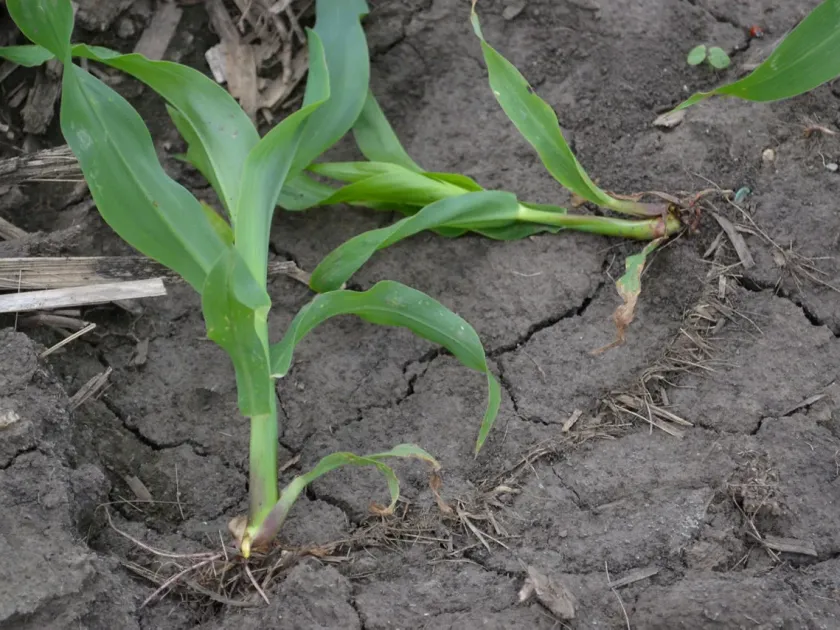
The primary symptom of this disorder is the complete or partial absence of the nodal (secondary) root system in young corn plants. During the 3 to 6-leaf stage, the primary roots stop growing, and the nodal roots fail to develop or remain as underdeveloped buds.
Plants affected by this syndrome appear stunted and show significant growth delays compared to healthy crops. A pronounced chlorosis of the leaves is often observed, resulting from the plant's inability to absorb nutrients due to root system failure.
In the field, affected plants often lean or lodge because they lack the structural support provided by the root system. Excavating an affected plant reveals a tapered or «pointed» appearance at the base of the stem, lacking healthy root structures.
The root zone at the crown may show only brown, necrotic buds that are incapable of supporting the plant's growth. Frequently, necrosis of the mesocotyl is present, which inhibits the transport of water and nutrients from the primary root to the shoot.
Damage typically occurs in patches across the field, appearing as areas of low-lying or wilted plants against the backdrop of a healthy, growing crop.
Pathogen
Rootless corn syndrome is not a classic infectious disease caused by a single pathogen but is classified as a physiological disorder related to plant development.
The core cause lies in unfavorable soil and climatic conditions that prevent the physiological processes required for the initiation and elongation of nodal roots during the critical early growth stage.
However, the necrotic tissues often serve as a substrate for opportunistic saprophytic fungi and bacteria present in the soil. Common soil-borne organisms such as Fusarium and Pythium species may colonize these damaged tissues.
Thus, the primary driver of the condition is an imbalance in hormonal growth regulation triggered by environmental stress rather than a specific infection.
Biologically, the syndrome represents a suppression of the meristematic activity within the crown nodes, which are responsible for establishing the secondary root system.
Conditions for development
The key environmental driver is rapid soil drying in the upper profile at the exact time when nodal roots are beginning to emerge and penetrate the soil.
Soil physical properties, such as high compaction or the presence of large clods, create physical barriers that prevent delicate root buds from penetrating the soil surface.
High air and soil temperatures combined with moisture deficits significantly amplify the stress impact on young corn plants.
The use of specific herbicides, particularly those with growth-regulating properties, can exacerbate the condition under certain stressful environmental factors.
Deep planting under dry conditions exhausts the seed's energy reserves, leaving insufficient resources to support the proper establishment of the nodal root system.
Why it matters
The main economic danger of this syndrome is a substantial reduction in yield, which can range from minor losses to complete crop failure in localized patches.
Lodging makes it impossible for harvesting machinery to collect the crop effectively, leading to significant field losses during the harvest process.
Even if the plant survives, its ability to fill ears is severely limited due to restricted water and nutrient uptake, leading to poorly developed and light grain.
A compromised root system makes the crop extremely vulnerable to drought throughout the entire growing season, as the plant cannot access deeper soil moisture.
Delayed development of affected plants results in uneven maturity across the field, complicating harvesting operations and increasing the costs of post-harvest grain drying.
Protection
The primary prevention strategy is to ensure optimal planting conditions, focusing on precise planting depth to encourage rapid and uniform emergence.
Effective seedbed preparation is essential to create a fine, uniform soil structure that retains moisture and allows roots to penetrate the soil easily.
Growers should be cautious with herbicide applications during early growth stages to avoid additional stress on the plants when environmental risks are high.
Choosing hybrids known for high seedling vigor and stress tolerance can significantly reduce the risk of rootless corn syndrome.
Strategic crop rotation and management of planting dates help avoid periods when the combination of temperature and soil moisture is likely to trigger the disorder.
Pathogens and affected parts
Affects crops · 1
Discussion
No discussions yet — be the first.