
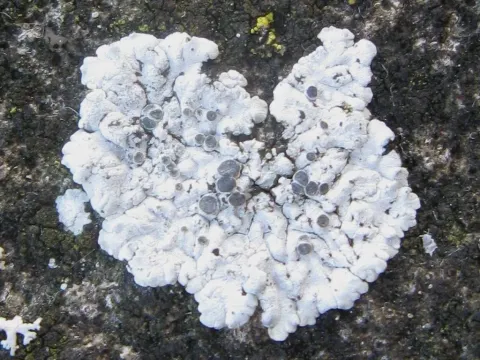
Solenopsora candicans
Solenopsora candicans
Solenopsora candicans is a species of crustose lichen belonging to the Ramalinaceae family. It is a symbiotic organism comprised of a fungal component and an algal partner.
What the section contains
Solenopsora candicans
From an agricultural perspective, this organism is categorized as an epiphyte. It utilizes the surfaces of tree bark as a substrate for attachment rather than deriving nutrients from the plant itself.
The organism reproduces through spores, which are effectively disseminated by wind and precipitation, allowing for colonization of adjacent trees and rocky surfaces.
While not a primary plant parasite, its presence is a biological indicator of slow bark renewal and a lack of active growth in the host plant.
The lichen forms a dense, crusty thallus that is remarkably resistant to harsh environmental conditions, including intense UV radiation and low moisture.
The primary symptom of infestation is the development of rigid, white-to-gray crusts on the tree trunks and main branches that are tightly adhered to the bark.
These crusts exhibit a fine, granular, or scaly texture. They do not flake off easily and often require mechanical force to be removed from the underlying bark surface.
In advanced cases, the crusts merge into large, irregular patches, effectively masking the original texture and color of the tree bark.
Unlike parasitic fungi, Solenopsora candicans does not typically cause immediate necrosis of the bark, but it does leave localized areas of suppressed tissue underneath.
The appearance of the bark becomes grayish or whitish, which is easily distinguishable from healthy, vibrant wood surfaces in an orchard.
The development of this lichen is highly favored by older, slower-growing trees where the bark accumulates for extended periods without shedding.
High relative humidity and poor air circulation within the canopy create an ideal environment for spore germination and long-term establishment.
Neglected orchards with dense planting schemes suffer more frequently from lichen colonization due to limited sunlight and consistently damp bark surfaces.
Proximity to other colonized surfaces, such as stone walls or untreated neighboring trees, facilitates the continuous supply of spores to the orchard.
While the lichen is drought-tolerant, it thrives best when there are periodic moisture events that allow it to remain metabolically active and expand its thallus.
The primary harm caused by this lichen is the inhibition of gaseous exchange through the bark, which is vital for the tree's overall metabolic processes.
The dense layer of the lichen acts as a physical barrier that keeps the bark surface consistently damp, creating a niche for pests such as scale insects and mites.
Trees covered in significant amounts of lichen often exhibit signs of physiological stress, including reduced vigor and increased sensitivity to seasonal temperature changes.
The accumulation of moisture under the crust can lead to secondary fungal infections or localized tissue decay, weakening the structural integrity of the bark.
Over time, the cumulative effect of reduced respiration and pest harboring leads to a gradual decline in the tree's health and eventual reduction in fruit yields.
The most effective management strategy involves mechanical removal of the crusts using specialized wire brushes or scrapers during the dormant season.
After physical cleaning, it is recommended to apply a disinfectant wash, such as a lime sulfur solution or a copper-based fungicide, to prevent recolonization.
Cultural practices, including regular thinning and pruning, are essential to improve air circulation and sunlight penetration, which discourages lichen growth.
- Regular orchard inspections.
- Balanced fertilization to promote bark health.
- Timely removal of deadwood and old growth.
Applying white latex or lime-based paint to trunks not only protects the tree from sunscald but also serves as a prophylactic barrier against spore settlement.