
Sooty bark disease
Cryptostroma
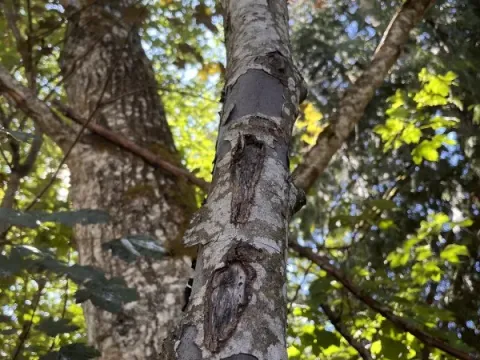
The most prominent sign of sooty bark disease is a thick, black, sooty layer of spores appearing under the peeling bark of the tree.
What the section contains
Sooty bark disease
As the disease progresses, the bark begins to crack and fall away, revealing large, dark, powdery masses of fungal spores.
During the growing season, affected trees often show canopy wilting, yellowing of leaves, and dieback, even in the absence of severe drought.
Cutting into the bark may reveal discolored wood, indicating that the fungal pathogen has penetrated the tree's vascular system.
In advanced stages, the tree appears sickly with sparse foliage and exposed patches of charcoal-like fungal growth on the trunk and branches.
The disease is caused by the fungus Cryptostroma corticalis, an ascomycete that specifically targets maple species.
The fungus develops beneath the bark, creating stromatic structures where it produces and stores its numerous microscopic spores.
It is classified as a bark necrosis pathogen that eventually compromises the entire integrity of the tree's wood structure.
The pathogen can remain dormant within the tree for long periods, showing no symptoms until environmental triggers initiate an outbreak.
The fungus is highly efficient in reproduction, releasing millions of spores that are easily dispersed by wind currents.
The development of sooty bark disease is strongly correlated with periods of high summer temperatures and prolonged water stress.
Trees located in urban heat islands or those suffering from drought are significantly more susceptible to successful fungal infection.
Mechanical injuries to the bark, caused by improper pruning or maintenance activities, provide easy entry points for fungal spores.
Wind is the primary vector for the transmission of spores, facilitating rapid spread from infected trees to healthy neighboring maples.
Lack of proper tree vigor makes it difficult for maples to defend against the invasion and colonization of this aggressive pathogen.
Sooty bark disease poses a major threat to maple populations, causing high mortality rates in both forest and landscape settings.
The decay caused by the fungus weakens the structure of the tree, creating a severe public safety hazard due to the risk of falling branches.
Beyond ecological damage, the spores are known to cause respiratory issues and allergic reactions in humans upon inhalation.
The financial impact of this disease is considerable, involving the removal of hazardous trees and costly cleanup operations.
The loss of maples significantly reduces the aesthetic and environmental benefits provided by these mature shade trees.
The primary control strategy involves the early detection and immediate removal of infected trees to eliminate the source of spores.
Infected wood must be disposed of properly, preferably through burning or deep burial, to prevent further spread of the pathogen.
All pruning equipment used on potentially infected trees must be thoroughly disinfected with appropriate fungicides or alcohol solutions.
Maintaining adequate soil moisture and tree health is essential to help maples resist the initial establishment of the fungus.
Continuous monitoring of maple populations is necessary, especially after seasons characterized by extreme heat and drought conditions.