
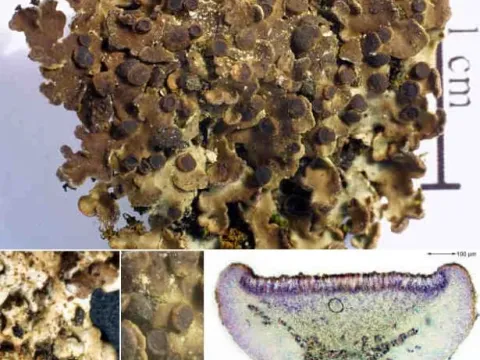
Solenopsora
Solenopsora
Solenopsora is a genus of lichens from the Catillariaceae family, which in agronomy are often incorrectly or simplistically classified as pathogens or epiphytes capable of colonizing tree bark.
What the section contains
Solenopsora
Biologically, this organism is a symbiotic complex consisting of fungal mycelium and algae, which attaches itself to the surface of plant tissues.
Although lichens are not parasites in the strict sense of the word, as they do not feed on the host's sap, their development often indicates a weakened state of the plant.
Species of this genus are most often found in regions with temperate and subtropical climates, preferring stable, humid habitats.
They spread through spores (ascospores) carried by the wind or via thallus fragments, allowing them to quickly colonize suitable substrates.
The primary external sign of this organism appearing on a plant is the characteristic patchy or crust-like growth on the trunks and skeletal branches of trees.
The thallus usually has a greyish, grey-green, or brownish hue, which allows it to blend with the color of the bark, complicating early diagnosis.
Upon close inspection, one can notice small fruiting bodies, called apothecia, which look like tiny dots or discs on the lichen's surface.
As they spread, colonies can cover significant areas of the trunk, creating a visual effect of coarsening and changing the bark's texture.
Unlike true plant diseases, there are no tissue necroses, rots, or pathological changes inside the wood caused by the direct influence of the fungus.
The development of these lichen colonies requires high relative humidity and a sufficient level of light in a garden or forest area.
They most often colonize old, weakened, or neglected trees with slow bark growth, which creates an ideal base for spore attachment.
Lack of proper care, such as infrequent pruning and dense crowns, contributes to the creation of a microclimate with poor ventilation, which is favorable for lichens.
Air pollution or stress factors that suppress tree growth indirectly accelerate colonization because natural bark renewal slows down.
Typical habitats include shaded parts of the garden where moisture after precipitation lingers on the surface of branches longer than usual.
The main danger lies not in direct toxic effects, but in creating favorable conditions for the development of secondary pests and pathogenic fungi.
Moisture often accumulates under the lichen layer, provoking premature softening of the bark and the development of rot processes in the deep layers.
The growth of colonies can hinder the plant's respiration through the bark lenticels, which negatively affects the physiological processes in the trunk.
The presence of large amounts of lichen on fruit trees is an indicator that the tree requires immediate agrotechnical support.
In neglected cases, they can cover the entry points for other pests, hiding their presence from the gardener until the stage of critical damage.
The primary preventive measure is the regular cleaning of trunks and large branches from dead bark using special brushes.
It is important to perform quality sanitary and formative pruning of the crown to ensure free air circulation and access to sunlight.
To combat the colonies, spraying trees with a solution of iron sulfate during the dormant period (early spring or late autumn) is used.
It is necessary to maintain a high level of agrotechnology, including proper watering and fertilization, to increase the plant's own immunity.
- Regular monitoring of bark condition.
- Whitewashing trunks with garden lime.
- Using fungicides if necessary.
- Removing infected branches in case of severe overgrowth.