
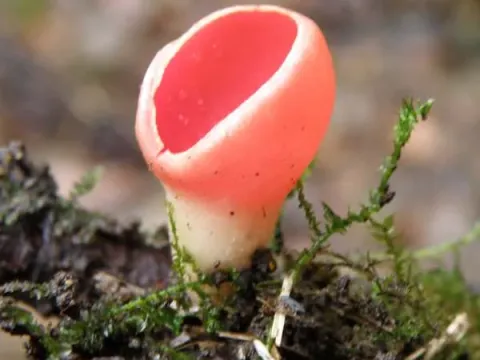
Scarlet elf cup
Sarcoscypha coccinea
The scarlet elf cup (latin Sarcoscypha coccinea) is an ascomycete fungus belonging to the Sarcoscyphaceae family. It is crucial to clarify that it is not a plant disease or an infectious agent.
What the section contains
Scarlet elf cup
This fungus is classified as a saprotroph. It obtains nutrients exclusively from decaying organic matter, specifically dead wood from deciduous trees, which is already in a state of decomposition.
The organism lacks the parasitic mechanisms required to infect living plant tissue, meaning it poses absolutely no risk to crops or healthy garden plants.
By breaking down wood, it participates in the natural recycling of nutrients, which is an essential process in maintaining healthy forest or soil ecosystems.
Therefore, its presence is a sign of ecological activity on decaying wood rather than an indication of a phytopathological problem.
The fungus is most easily identified by its striking, cup-shaped fruit bodies that emerge in early spring, often shortly after the snow melts.
The inside of the cup is a vibrant scarlet red, while the exterior is a lighter, whitish shade, often appearing slightly fuzzy due to fine hairs.
Fruit bodies typically range from 1 to 5 centimeters in diameter and are attached directly to buried or decaying wood lying on the ground.
Younger specimens usually have curled-in edges, which expand and flatten as the fungus reaches maturity.
They are often found in small clusters, contrasting sharply against the damp soil, leaf litter, or dark bark of their substrate.
The scarlet elf cup requires specific environmental conditions to thrive, most notably high moisture and cool temperatures typical of late winter and early spring.
The fungus favors shaded environments where humidity remains high, preventing the fruit bodies from drying out before spore release.
The presence of well-rotted wood from hardwoods, such as willow, maple, or alder, is the primary requirement for its colonization.
These conditions are most frequently met in woodland areas or damp corners of large gardens where organic debris accumulates.
In highly managed agricultural fields, the absence of such woody substrate and the presence of intensive cultivation usually prevent the establishment of this fungus.
The scarlet elf cup causes no harm to agricultural or horticultural crops, as it has no capability to colonize living plant tissues.
It does not cause rot, necrosis, or systemic infections in trees or shrubs, effectively remaining a neutral or beneficial inhabitant of the ecosystem.
Because it is restricted to dead wood, it does not compete with growing plants for water or nutrients in the root zone.
The fungus produces no harmful metabolites that could suppress the growth of cultivated crops or affect soil health negatively.
Consequently, it is not considered a pest and does not warrant any form of management or control within a farm or garden environment.
As the scarlet elf cup is not a plant disease, there are no control protocols or fungicide treatments associated with it.
If the visual appearance of the fungus is undesirable, simple sanitation measures, such as removing rotting branches or wood debris, will naturally eliminate its habitat.
Keeping the garden clear of old, damp wood effectively stops the fungus from finding a suitable substrate to colonize.
Good horticultural practice, such as regular clearing of woody debris, is more than sufficient to manage the presence of this fungus.
- Remove decaying wood and brush;
- Maintain proper drainage;
- Keep the garden area tidy.