
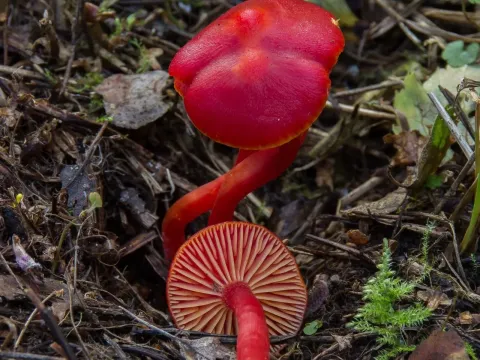
Scarlet waxcap
Hygrocybe coccinea
It is crucial for agronomists to distinguish that Hygrocybe coccinea, or the scarlet waxcap, is not a plant disease or a pathogen.
What the section contains
Scarlet waxcap
This species belongs to the Hygrophoraceae family and functions as a saprotrophic organism, living on decaying organic matter in the soil.
The fungus lacks the physiological machinery to infect or parasitize living plant tissues, making it harmless to crops.
Its biological cycle is strictly confined to the decomposition of plant residues, which plays a vital role in natural nutrient cycling.
Therefore, any identification of this fungus within a field should not be considered a disease outbreak or a threat to commercial production.
The scarlet waxcap typically develops in soils with low nutrient levels, particularly avoiding areas with heavy mineral fertilizer application.
It thrives in undisturbed ecosystems such as old pastures, meadows, and forest glades where the soil structure remains intact.
High levels of atmospheric humidity and moderate autumn temperatures are primary triggers for the emergence of its fruiting bodies.
The fungus is highly sensitive to chemical interventions and synthetic pesticides, which often lead to its rapid disappearance from the site.
Optimal development conditions are found in areas with long-term ecological stability and limited human impact on the soil layer.
This fungus poses no risk to agricultural yield and does not cause any form of plant necrosis, wilting, or root dysfunction.
There is no economic harm associated with the presence of this species, as it does not compete with crops for light, water, or nutrients.
The organism does not produce mycotoxins that could be detrimental to the growth of cereal, vegetable, or horticultural plantings.
As a saprotroph, its presence is a sign of healthy soil organic matter processing rather than a manifestation of plant pathogenic activity.
No agricultural damage has ever been attributed to this species, maintaining its classification as an ecologically neutral inhabitant of the soil.
There are no control measures or prevention strategies required for Hygrocybe coccinea, as it is not a threat to plant health.
The application of fungicides intended for plant protection is entirely unnecessary and ineffective against this saprotrophic fungus.
Effective soil management involves preserving natural microbial biodiversity, which these fungi contribute to, rather than attempting to eradicate them.
Agricultural practices should focus on maintaining healthy soil structure, which naturally supports beneficial fungal communities.
In conclusion, the presence of the scarlet waxcap serves as an indicator of an undisturbed and chemically clean environment in agricultural settings.